Search more

Tuesday, March 31, 2009

Conficker Predictions - Doomsday Scenarios for April 1

conficker worm spells doom, or does it?Graphic: Diego Aguirre
Doomsday is nearly here. Well, maybe.

The fear-inducing Conficker worm is set to explode (or something) this Wednesday, April 1. Wondering what the hell that actually means? You aren't alone.

No one knows exactly what Conficker will bring, but plenty of theories are floating around. Some take on apocalyptic tones, while others seem more like nonchalant groans. Before you unplug your computer and brace yourself in the fetal position, though, consider some of the possibilities and how likely they appear to be.

1. It'll be Y2K all over again.

Just picture it: Computers worldwide simultaneously freak out. Banks go haywire, airports shut down... -- oh, wait a minute. None of that stuff ever happened.

That's exactly what a lot of security experts are expecting to see this week: a collective sigh of relief as all the hype turns into a big fat punchline, ripe for months of late night comedy milking.

"The truth is, there will be no April 1st outbreak, despite what some of the press stories have said so far," says Joe Stewart, director of malware research with SecureWorks.

"The probability of a major [Conficker]-related event taking place on April 1 is really not very likely," agrees Vincent Weafer, vice president of Symantec's security response group.

Armageddon? Fuh-get-it.

2. Hackers will take over the world.

On the other end of the spectrum, some are suggesting that the worst could actually occur. Just look at these sentiments from a not-at-all sensational story by U.K. tabloid The Sun (and yes, these are all unmodified, direct quotes):

• "Millions of computers around the world could go into meltdown."

• "The aggressive bug could be hiding on your PC at home right now, waiting to kick in."

• "For the hackers, it's like having a virtual army at their fingertips."

• "They could also plunder information, including your bank details."

Meltdown? Hiding in my home? Army? Plunder?! That fetal position is starting to look more appealing.

But really, most people who study security for a living say this extreme type of scenario seems awfully unlikely. What's more, research released just today by IBM Internet Security System's X-Force (note to self: rename bowling team "The X-Force") suggests Conficker's presence in the U.S. has been greatly exaggerated. Fewer than 6 percent of Conficker infections are in North America, IBM says. The majority are in Asia, followed by Europe and then South America.

The smartest thing you can do right now is to check if you're infected -- and, if you are, run a removal tool to make the fix before midnight.

3. Every infected computer will lose all of its data.

The Conficker event scheduled for April 1 could contain code telling the bug to wipe out the hard drives of every personal computer in sight. Key word there: could.

The truth, as PC World's Erik Larkin points out, is that the folks behind malware are typically looking to make some sort of measurable gain. As valuable as your photo collection from last year's family vacation is (and yes, I know about the bikini pics), odds are, it's not what a hacker is after.

4. Spam, spam. Lots of spam.

One way that gain could be accomplished is through spam -- and lots of it. With millions of machines believed to be affected worldwide, Wednesday's potential communication expansion could give Conficker's creators the power to blast us with bundles of annoying new e-mails. That threat, some say, could be very real, as could the idea of targeted denial-of-service (DoS) attacks.

Still, any DoS attacks would more likely be aimed at corporate networks, not individual users, and many major institutions have already taken steps to protect themselves.

5. Jerry Yang will suddenly become an omnipotent force, ruling the entire world from a top-secret Silicon Valley bunker.

Hey, I'm just saying -- anything's possible here. And of all the scenarios we've considered, this final one may be the most troubling. I mean, what anti-virus program could possibly protect us from that frightful fate?

Fetal position, here I come. I'll be under my desk if anyone needs me.

Three Reasons Why Microsoft's App Store Will Thrive

Microsoft's plans for its mobile application store just may change the way consumers look at apps and the Windows Mobile operating system. Not only has Microsoft changed contentious policies still enacted in Google and Apple's respective app stores, it has partnered with some of the most popular contemporary content providers and introduced original strategies for businesses. Here are three major reasons why I think Microsoft could blow its competition out of the water.

Refund Policies

If you're dissatisfied with the ridiculous farting application you just bought, Microsoft will take it back for a full refund within 24 hours. Microsoft refunds its 30 percent share of the sales price, and developers return their 70 percent share. Google has a similar policy, but Apple's refund policy has infuriated developers. Apple makes developers pay back the full amount of the application, and still takes its 30 percent cut, shifting the financial burden on developers.

Pricing Strategy

Apple mandates that applications be purchased through iTunes, and Google makes use of Google Checkout. Microsoft, on the other hand, has decided to allow customers the choice of either paying via credit card or have the charges planted on their mobile phone bill. This is a brilliant move, and though financial arrangements between Microsoft and cellular carriers have not been disclosed, it's safe to assume money is changing hands. This makes carriers happy, and strengthens relationships with those who are actually moving the phones. It also makes consumers less likely to second-guess purchases during the process of entering credit card information into a phone.

Content Partnerships

While some of Microsoft's content partnerships are nothing new -- Facebook, Pandora, MySpace, etc. -- the company has built a strong team of supporters. Some companies who have shaken hands with Microsoft include: CNBC, Accuweather, Ilium Software, Resco, Spb Software, WebIS, Sling Media, Zagat Survey, Namco, Netflix, and Electronic Arts Mobile. With that team of respected content providers standing in Microsoft's corner, you can expect developers to generate some very original apps. Even Microsoft's Facebook app will be different than other mobile versions: It will allow users to record and upload video to their Facebook pages.

More details on Microsoft's App Marketplace are expected to be issued as CTIA continues. Expect Microsoft to build a competitive edge as it learns from Apple and Google's successes and mistakes.

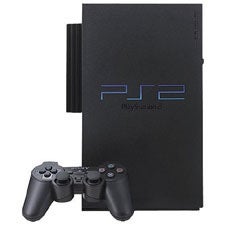
Sony Slashes the Price of the PlayStation 2

Looking to scoop up a PlayStation 2? Starting tomorrow, April 1, Sony will cut the price of its gaming console to $100, down 25 percent from its current price of $130. Today's announcement is the third price cut for the PS2 since Sony's first discount in 2002.


Rumors had swirled in recent days that Sony was set to make a major PlayStation 3 announcement today. Industry watchers speculated that the company would announce a brand new browser, online content for the PS3, or perhaps a release date for God of War III. But the biggest rumor was that the PS3 was getting a $100 price drop as a way for Sony to improve slumping sales. In the end, it turns out that the rumor mill was way off.

According to December 2008 figures from Nielsen, the PS2 is still the most popular gaming system in use today. For its part, Sony doesn't seem to be letting up on development for the system even though its successor, the PS3, has been out for more than three years. Sony believes the PS2 has a 10-year lifecycle, meaning new games for the PS2 should wind down sometime in 2010. By year's end, Sony says there will be 1900 available titles for the PS2, including new releases like MLB 09 THE Show and MotorStorm: Arctic Edge.

While the attention of hardcore gamers is now focused on the next generation of systems like the PS3 and Microsoft's Xbox 360, the lowered price tag might mean a second life for the PS2. Playing action-based games like Call of Duty 2 or Unreal Tournament 2004 may help you improve your vision, according to a recent study by the University of Rochester. While neither of those games are available for the PS2, enterprising users (or doctors) just might be able to find PlayStation equivalents.

Conficker Set to Strike: Protect Yourself with These Tips and Tools

protect yourself against the conficker worm

Graphic: Diego Aguirre
Security watchdogs warn that millions could be affected by the Conficker worm tomorrow - unfortunately this is not in an April Fool's Day joke. Over nine million PCs are already infected and a new variant of the virus could threaten those who didn't patch their PCs with the latest security updates.

Symantec warns that on April 1st Conficker "will simply start taking more steps to protect itself." After tomorrow, machines infected with the new "C strain" of Conficker may not be able to get security updates or patches from Microsoft and other security products vendors, says the company. Known also as Downadup or Kido, Conficker is a worm whose purpose security researchers couldn't decipher yet.

How do I stay safe?

Security experts recommend that you run good antivirus software (such as Norton or McAfee) and that you keep updated with all the latest patches and updates from both Microsoft (Vista and XP) and for your antivirus provider. "Free" security scans from various websites are not recommended. Google searches for Conficker protection software are not advisable either, as they could redirect you sites that will actually infect you. Users who received all the automatic updates from Microsoft should be already protected from Conficker.

How do I know if I'm infected?

Spreading across networks, Conficker finds vulnerable computers and automatically disables security services (like Windows Update and antivirus) and blocks access to various well-known security firms' websites. Another symptom of Conficker infection is when your Internet connection is running suspiciously slow, without any apparent reason. The best way to find out whether you already have Conficker is to use one of the Microsoft, Symantec or McAfee security tools Aa free trial version of these should at least help you remove the virus and keep you safe tomorrow).

More on how to keep safe from Conficker can be found here and here.

More on how Conficker works can be found here.

Motorola Evoke QA4: Best Touch-Screen From Motorola Yet

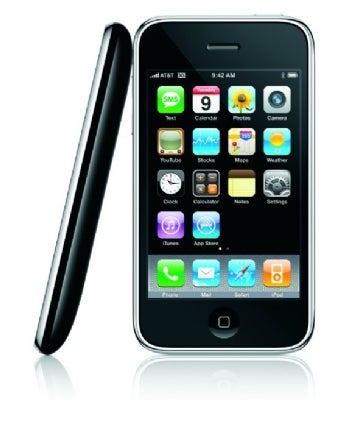
Motorola has announced its latest offering the Evoke QA4 - a touch-screen cell phone which represents the company's second attempt at offering an iPhone-like handset. This time Motorola looks as if it got it right with this Web-savvy Evoke QA4 that comes equipped with a virtual QWERTY keyboard, and what it calls "social" features such as a MySpace Mobile application, conversational style SMS and e-mail displays, and a full-HTML Web browser-able to display standard Web pages. This is a predecessor to Motorola's clumsy Krave ZN4 "clear flip" touch-screen.

All programs on the Evoke are widget-based and the home screen is fully customizable. Pre-loaded widgets available at launch include MySpace Mobile, Follow Me Weather, Google Quicksearch, Google Picasa, RSS Reader, USA Today Mobile, YouTube and Picasa.

The 3G (CDMA) Evoke also has GPS, stereo Bluetooth, noise reduction, a 2-megapixel video and still camera, approximately 330 minutes of talk time and up to 8GB of external storage capacity. The Evoke will be available before the summer, but Motorola has yet to announce pricing.

At first glance, it looks like Motorola built the Evoke based on a list of features missing from the iPhone (pre-OS 3.0 that is). However, if Motorola really wants to compete with other smart phones, designs for the Evoke need to go farther. The slide out phone pad for example would have been more effective as a slide out QWERTY keyboard. Wi-Fi is also noticeably absent from the Evoke's features list, and why does the Evoke feature MySpace integration above Facebook, Orkut or other social networks?

Despite these shortcomings, the Motorola Evoke seems like a nice offering. Based on the general timelines from both Motorola and Palm, it looks like the Evoke and the Palm Pre will hit store shelves around the same time. It will be interesting to see how those two devices stack up against each other, and what the price difference will be.

The Evoke's introduction raises some other interesting questions as well. Does this mean that Motorola will be opening an app store to support the Evoke and future devices? Based on information on Motorola's site, the Evoke seems to be Java-based, so what is going on with the rumored Motorola Android device and how will it differ from the Evoke? Since the Evoke clearly mimics the iPhone's basic approach of a touch-based home screen with widgets, will Apple live up to its threats and go after Motorola to vigorously protect its patents? Will the Evoke use Flash to go along with its full-HTML browser?

Mobile device action is really starting to heat up for this summer with the introduction of new devices from Motorola and Palm, and the guessing game surrounding Apple's Worldwide Developers Conference in June. Of course, with continuing economic troubles and a slowing market, all three companies need to be very sensitive to pricing as disposable incomes shrink across the country.

Monday, March 30, 2009

Netflix Raises Blu-ray Rates: Time to Switch to Blockbuster?Netflix Raises Blu-ray Rates: Time to Switch to Blockbuster?

Buying a new movie on Blu-ray may be getting cheaper these days, but renting one is actually getting more expensive. Netflix has announced it's raising its Blu-ray surcharges, replacing the $1-a-month flat rate introduced last fall with a new tiered alternative. Translation: Your bill will go up by anywhere from $1 to $8 per month, depending on which plan you've chosen.

Thinking of jumping ship and switching over to Blockbuster? Read on to see if it'd be worth your while.

Netflix's New Blu-ray Plans

Artwork: Chip Taylor
First, how the Netflix Blu-ray change will affect you: Basically, the higher your monthly bill, the higher your Blu-ray fee will soon be. If you pay $13.99 a month for the two DVDs at a time plan, for example, you'll have to pay $3 a month extra for access to Blu-ray titles under the new system. On the other end of the spectrum, if you pay $47.99 for the eight DVDs at a time plan, your Blu-ray surcharge will jump to $9 a month. (You can find a full list of all the Netflix rate plans and how they'll be affected here.)

As for the reason driving the change, about 10 percent of Netflix users now rent Blu-ray discs, the company says, compared to what was described as a "very, very small, single-digit percentage" this time last year.

Customer Reaction

The equations may make sense, but that doesn't mean customers are happy with adjustment. The announcement on the official Netflix blog is already filled with irritated comments.

"I've been holding off investigating alternatives, but now that this price hike is going in, it's time to look at what else is out there," one user says. "Will my extra money guarantee that I won't wait days/weeks for a new release Blu-ray like I do now?" asks another.

Other commenters suggest the amount of titles available isn't high enough to warrant the change, noting that they often receive DVD even when requesting Blu-ray due to limited stock.

Should You Switch?

So, the big question: How do the adjusted costs stack up with Netflix's main competitor, Blockbuster? The simple answer is that it depends on how much you're renting. Blockbuster does automatically include Blu-ray access within its base prices. Still, in some cases, Netflix will remain cheaper -- even with the upcoming change.

Here's how the plans stack up. Note that Blockbuster has fewer plans than Netflix, so your specific Netflix plan may or may not have a direct comparison.

• 1 DVD at a time, limited to two per month, with Blu-ray

Netflix: $5.99

Blockbuster: $9.99

• 1 DVD at a time, unlimited per month, with Blu-ray

Netflix: $10.99

Blockbuster: $11.99

• 2 DVDs at a time, unlimited per month, with Blu-ray

Netflix: $16.99

BBV: $16.99

• 3 DVDs at a time, unlimited per month, with Blu-ray

Netflix: $20.99

BBV: $19.99

To sum it up, if you rent one or two DVDs at a time, you'll end up paying either the same or more by switching to Blockbuster. If you're renting three DVDs at a time, though, Blockbuster will end up costing slightly less. Of course, this isn't taking into account the perks each company offers -- namely, online streaming from Netflix and free in-store exchanges with Blockbuster -- so be sure to consider those in your decision, too.

Netflix's new rates go into effect starting April 27. If you don't want to pay them, you'll need to go into your account settings and disable Blu-ray access before that date.

Six New Phones from AT&T: Have a Look

Just days before CTIA kicks off in Las Vegas, AT&T announced its attractive spring lineup of handsets on Monday. The carrier is focused on bringing texting and e-mail capabilities to everyone, whether they're a teenager or a business executive. And while messaging phones can run a bit on the boring side, the new lineup has some enticing choices. Here are a few that caught my eye:

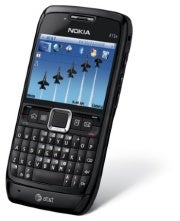
Nokia E71x

Last fall when I reviewed the unlocked E71, I was blown away at its svelte 0.4-inch profile and sophisticated design. In fact, my biggest gripe about the E71 was its hefty unlocked price. And when I heard that it would be available this spring at a subsidized price, I figured it would still be fairly expensive. Not so: The E71x will be coming to customers within a few weeks at the amazingly reasonable price of $100. The E71x has a black steel finish (as opposed to the unlocked's silver finish), comes with 3G and Wi-Fi connectivity, a 3.2 megapixel camera, integrated A-GPS and runs Symbian S60 platform.

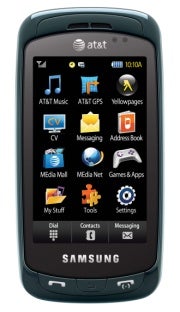
Samsung Impression

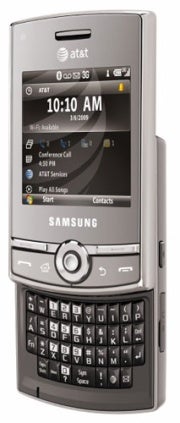
With the first commercially available AMOLED (active-matrix organic light-emitting diode) screen, the Samsung Impression promises an extraordinarily bright and clear display. And you can fully take advantage of the Impression's generous 3.2-inch screen, as it comes with a full Web browser. The Impression also touts an accelerometer, assisted GPS and a full slide-out QWERTY keyboard. I am a little disappointed, however, that the camera specs weren't beefed up a bit. A 3-megapixel camera is fine, but wouldn't it be nice to view higher quality photos on this fantastic display? Nonetheless, I am really looking forward to checking out the Impression. The Impression will be available on April 7 for $200 with a two-year contract.

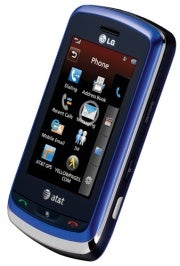
LG Xenon

The LG Xenon is a nice option for someone looking for a touchscreen/QWERTY keyboard combination, but not necessarily a smartphone. The Xenon has some modest, but respectable specs: A 2-megapixel camera, GPS integration, Bluetooth 2.0 and Wi-Fi connectivity. The UI is rumored to be similar to Samsung's TouchWiz interface and the widget-based interfaced seen on the LG Prada II. The Prada II's UI has seven widgets (an analog clock, a calendar, an FM radio, a music player, a world clock, notes, and image slideshow) that you can move around and arrange to your liking. If the Xenon's UI is anything like the LG Prada II's, customers will be pleased at its ease-of-use and touch-friendliness. The Xenon will be available on April 8 in black, blue and red for $100 with a two-year contract.

Samsung Propel Pro

The Samsung Propel Pro has the same design as its predecessor, the non-smartphone Propel, but has a bevy of upgrades. Powered by Windows Mobile 6.1, the Propel Pro sports a slide-out full-QWERTY keyboard, Wi-Fi connectivity, a 3-megapixel camera, an optical joystick and expandable memory up to 32 GB. It isn't the slickest device, but it has a nice balance of business and entertainment features. And it's affordable: The Propel Pro is available in April for $150 with a two-year agreement.

Other new phones from AT&T include the LG Neon, an affordable touchscreen slider, and the Samsung Magnet, a messaging phone aimed at teens. Check back for more CTIA coverage this week including more in-depth analysis and impressions of these phones and more.

Dell Unveils Colorful Inspiron Towers

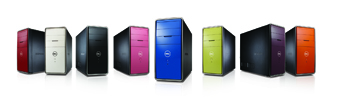
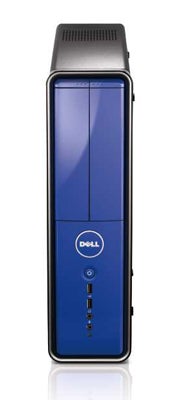
Dell capitalizes on the trend of putting a personal touch on your computer by introducing today new Inspiron mini-tower and slim tower models, available in eight different colors.

The new systems will ship in China first, and in the United States later this year.

The vibrant colors cover a wide spectrum of the rainbow: eight different colors: Piano Black, Pure White, True Blue, Formula Red, Tangerine Orange, Spring Green, Plum Purple and Flamingo Pink. And the mini-tower and slim-tower cases feature a redesigned, clean front--a refresh of Dell's current offerings.

System configurations will include the choice of Intel Celeron, Intel Core 2 Duo, and Intel Core 2 Quad; or AMD Sempron, Athlon X2, and Phenom X4 processors. Default configurations will feature integrated graphics, with discrete graphics options available. Memory options will go up to 8GB; storage up to 750GB in the slim tower, and 1TB in the mini-tower. The mini-tower model offers dual-optical drive options, including a Blu-ray Disc reader.

I'm surprised by the components that remain optional, though: A 19-in-1 media card reader and HDMI connectivity. A media card reader is integral to most PC users today; why have to have a separate card reader lying on your desk when the reader can, and should, be built into the system? Likewise, HDMI is growing in its importance; it would be nice to have this port on-board by default--especially if one eventually were to migrate a system into a living room environment.

I'm also surpised that there are just six USB ports (and only two of those are front-accessible). I can name more than six devices I'd attach in a nanosecond. And I sure would prefer not to rely on a USB hub to do so.

Another surprise: No 2TB hard disk drive option in the mini-tower. With 2TB as the new gold standard of storage capacity, 1TB feels downright paltry.

To Improve Your Eyesight, Fire Up the Shoot-'em-up

call of duty 2, video gameWant to improve your eyesight? Fire up your gaming machine and start shooting the bad guys in action-packed video games. That's right, those grotesque, gratuitous, and gory shooter games may be an excellent tool for improving eyesight. The conclusion comes from a study published in the journal Nature Neuroscience, and was conducted by the University of Rochester.

call of duty 2, games, video gamesAccording to the study, playing action-based video games improved the contrast sensitivity function (CSF) in test subjects. If you suffer from low contrast sensitivity it may be harder for you to see at night, pick out spots on clothing or pick up on facial expressions. Contrast sensitivity is also one of the most easily damaged functions of the human eye.

During the study one group of subjects played Activision's Call of Duty 2 or Atari's Unreal Tournament 2004, while another group played The Sims 2. Both groups had 50 hours of gaming time over nine weeks. By the end of the study, participants in the action group had noticeably improved their CSF, compared to those in the Sims 2 group.

The study also said the action group kept their improved CSF for months and sometimes even years. This is particularly encouraging news for those who suffer from decreased CSF, since previous methods of sight training didn't show dramatic signs of improvement and they didn't last. The results of this test are also similar to results discovered by the University of Rochester in a 2007 study, when test subjects reportedly improved their general eyesight by 20 percent after playing action-based video games.

However, like anything, video games may only be helpful in moderation. According to another study published by the journal of the American Academy of Pediatrics, sleep patterns, as well as verbal and cognitive abilities diminished in children after "excessive" gaming. Video games have also been accused of contributing to obesity, drug abuse and general poor health.

Then again, video games have also been credited for improving mental health and improving players' biology. This latest study may laud video games for improving eyesight, but who knows when another study will come along that completely debunks this one. The University of Rochester's study may also be of little use to you as a defense for your next Halo 3 marathon. The study cautions that "not all video games induce" noticeable benefits. In other words, only a doctor can tell you which games are improving your eyesight.

Disney and YouTube Close to Content Deal, Report Says

youtube and disney to strike deal on offering ESPN and ABC content

Google is reportedly in talks with Disney to stream ESPN and ABC television programming such as "Desperate Housewives," "Lost," and "Ugly Betty" to YouTube. In a rumored twist to the negotiations YouTube is pressuring Disney not to cut a deal with rival Hulu to provide Disney-owned content to the site, according to reports from the site PaidContent.org.

The arrangment between YouTube and Disney would be the usual ad-supported model. However, PaidContent.org is reporting YouTube is flirting with the idea of negotiating a deal with Disney that would put a pay-to-play scheme into place for full episodes of ESPN and ABC content on YouTube. The report is not clear on whether pay-to-play means you pay or Google pays Disney through a pay-per-click scheme. Regardless, here's the kicker: the full-episode deal with YouTube may be dependent on Disney killing any deal with Hulu.

The notion that YouTube may want a deal with Disney that handicaps Hulu shows how much the competition is heating up between streaming Websites. YouTube has had to play a bit of catch-up with its new rivals since the explosion of "TV online" in 2007. The old YouTube, which used to be the home of bizarre and the off-the-wall videos, has started to disappear due to copyright lawsuits and bizarre restrictions imposed by agreements with recording companies. At the same time, Google is starting to expand YouTube's offerings with Hollywood movies and high-definition content. Keeping Mickey Mouse away from Hulu falls right into YouTube's new strategy of embracing a wider variety of commercial content.

For Disney, the choice is a tough one, since YouTube represents 41 percent of the U.S. online viewing market; but it's entirely possible that Hulu and similar sites could chip away at that lead over time. Hulu partners Fox and NBC have apparently offered Disney full partnership in Hulu if it licenses content to them. There's also the question of whether Disney wants its videos lost amid a sea of user-generated videos on YouTube.

However, the suggestion that Disney is even considering this deal may indicate that Hulu is losing some of its original appeal. Hulu's ties with CBS are undoubtedly strained since it recently pulled Hulu videos from CBS-owned TV.com, and CBS has never been big on licensing its content to Hulu. If Hulu loses out on ABC content as well, then the lines may be drawn between the major networks as they try to figure out the online world.

Sneak Peek at Skype for iPhone, Available Tuesday

skype finally makes it to iphone

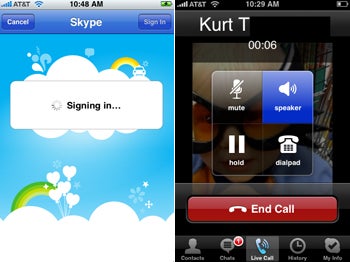
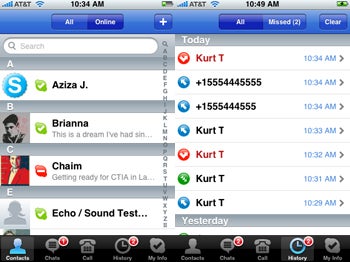
Skype is set to launch its iPhone application Tuesday, bringing its much-anticipated Net-based phone service to Apple's mobile platform. With the Skype iPhone app, users will be able to make free calls using Wi-Fi to other Skype users as well as use their Skype accounts to make reduced price calls to traditional landline phones. Skype announced its iPhone application will be available on Tuesday for free, with a version for the BlackBerry available in May. Mobile versions of Skype are already available for Nokia, Windows Mobile, and Google Android phones.

From what we can tell, the Skype for iPhone looks great; but it has some drawbacks. One disappointment is that users won't be able to place calls over cellular networks, but only via Wi-Fi. Still, for international callers especially, Skype's iPhone app will save callers money by allowing them to avoid AT&T's traditional wireless phone network and adds the convenience of allowing Skype users to use their iPhone handset for Skype calls.

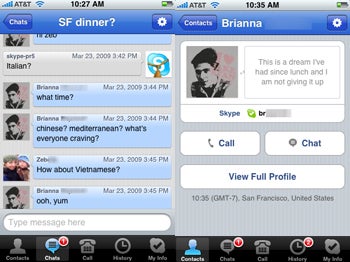
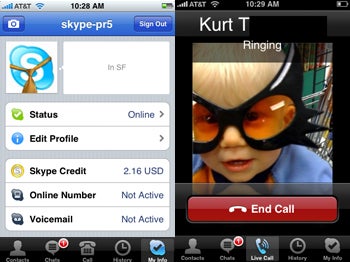
Looking more like a traditional iPhone app rather than the desktop Windows counterpart most of its 400 million users are used to, Skype for iPhone features five tabs at the bottom of the screen, displaying contacts, chats, a calling panel, call history, and your profile (with Facebook-style status).

Skype for iPhone will use phone numbers directly from your phone's address book, so no more nasty duplicated contact lists. It even displays your contacts' photos (if they have one set up on Skype). Conference calling is available, but for the moment you can only take part in one if someone invites you.

You can also chat with your Skype friends, but unfortunately this is the only thing (besides seeing who's online) you can do over a cellular network. Skype for iPhone places calls only via Wi-Fi, not differentiating itself much from the other voice apps in the App Store (Skype for T-Mobile G1 can place calls over 3G).

Skype for iPhone is still a young app and is short on some of the features its desktop counterpart has. SMS, video and proper conference calling, file transfer, and voicemail are missing from this first version, but let's hope they will make their way in future versions.

iPod Touch users will also be able to enjoy Skype, but this would require them to purchase a microphone, or headphones with built-in microphones (like the iPhone's).

Instantly Back Up Desktop Files and Folders to Your Webmail Account

I'm a big fan of making backups of important files by e-mailing them to yourself. For example, suppose you just finished a lengthy school paper or business presentation. By e-mailing a copy to a Web-based e-mail account, you immediately have a backup that lives "in the cloud."

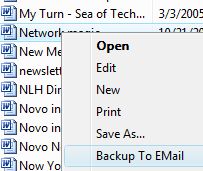
makes this a snap for Gmail users. (It also works with other Webmail services, provided you can provide the necessary SMTP server info.) All you do is right-click any file (or folder--the program will automatically Zip them for you) and choose Backup to Email.

Presto! The program instantly sends your file(s) to your Webmail account. Obviously you can do likewise with your everyday e-mail client, but that requires considerably more clicking. This is a two-click timesaver, one that I hope will encourage you to make on-the-fly backups of critical files.

After all, you never know when disaster may strike your PC. (I know, ominous, right?)

Sunday, March 29, 2009

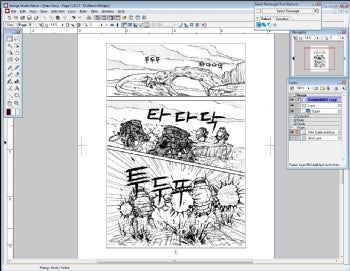
Draw Comics Easily With Manga Studio Debut

Manga Studio is known around the comics professional world as the go-to comics art application. Why? Unlike Photoshop, which is geared toward all around image manipulation, Manga Studio is designed from the ground up with the comics artist in mind. It includes numerous tools for toning, speed lines, lettering, and perspective. Those who master Manga Studio in their comics creation can often reap enormous timesaving and quality benefits. There are two Manga Studio variations: the inexpensive Manga Studio Debut 4 for beginning artists, and the full-featured Manga Studio EX 4 for the hard-core professional. This review is for the Debut version.

New to Manga Studio Debut 4 is full color support, something lacking in the previous versions due to manga's usual black-and-white nature. Previous versions of Debut also fudged the lettering support, forcing you upgrade to the $300 EX version to letter correctly. Debut 4 now has full access to text and preset word balloons, though you can't make your own balloons in Debut.

Webcomics artists who create their work from the ground up digitally with a pen tablet (that is, they don't pencil traditionally and then scan in) will find the $50 Manga Studio Debut 4 a huge bargain compared to Photoshop, which can run hundreds of dollars.

If you're an established comics or manga professional, though, there are several limitations to the Debut version compared to the full EX version. You can't import anything but BMP or JPG images, both of which are useless for publishing purposes, as they don't support layers or lossless images. Also, you can only export in those two formats plus Photoshop format, and the point of Manga Studio is to avoid using Photoshop when at all possible. This is meant as a replacement, not a supplement. Debut also doesn't support 3D objects, converting 2D images to line drawing, and many other features in the full EX edition.

Those looking to break into professional manga print publishing will want to spring for the full $300 Manga Studio EX. However, hobbyists and webcomics and webmanga creators will feel right at home with Debut, and will save a lot of money in the process.

Police Chief Shows Why Texting, Driving Don't Mix

It's almost too easy. Federal Way, Wash. Police Chief Brian Wilson rear-ended a car at an intersection when he was checking his BlackBerry. He received a reprimand (consistent with department policy when officers are in collisions that cause less than $700 in damage) and has apologized to his community. Federal Way is a city of about 90,000 south of Seattle.

No word on whether Chief Wilson was fined $101 as provided by Washington state law against texting when driving. It's considered a "secondary infraction" -- violators are written up only in conjunction with another infraction (such as causing an accident?).

The police chief, who said he was checking news headlines at a traffic light, is certainly embarrassed, but his experience does dramatize the danger of texting while driving. Washington was the first state to ban it (back in 2007; the state didn't require hands-free cell phone use while driving for another six months). Of course, texting and talking on cell phones in ways that impair driving could always be cited as part of a broader prohibition on any distractions that impede safe driving. (If you end up in an accident, that's pretty much proof that the other activity was an impediment). The engineer in the Metrolink accident in Southern California last fall was apparently texting shortly before the collison.

I was surprised to learn that few jurisdictions are really cracking down on texting while driving. New Jersey followed Washington and imposes a $100 fine; following were Louisiana, Minnesota, and Alaska. California banned it last year, but fines violators only $20 for the first offense and $50 thereafter. In New York, Nassau and Suffox counties banned texting while driving. Some states (Indiana, Rhode Island, Massachusetts) specifically target drivers under age 18. More are in the works.

A May 2008 study by insurance company Nationwide found technology provides roughly half of the distractions while driving; also, about half of the drivers surveyed also said they've been hit or nearly hit by someone using a cell phone behind the wheel. Still, 81 percent of drivers say they've talked on their cell phones while driving, and 18 percent admitted texting while driving. Of the 18- to 30-year-old drivers, 89 percent talk and 39 percent text.

It's a rare driver who hasn't done something distracting while driving and gotten away with it, but that doesn't mean it's safe. It also doesn't mean you'll get caught; for something like texting or chatting on a cell phone (hands free or not), it's probably not the law that will stop you. I've been remembering something I heard years ago in traffic school (yep, the Saturday time-sink that keeps a speeding ticket secret from your insurance company): For most of us, driving is the most dangerous thing we do all day. Outside of sky-divers or pilots or firefighters or cops or some other dangerous professions, getting behind the wheel of a vehicle that weighs thousands of pounds and travels 60 miles per hour is probably the most dangerous thing we do; we probably ought to focus.

Go ahead and crack the obvious jokes about Chief Wilson; but I think he offers us all a cheap reminder of what we already know.

Show Off Your iTunes Library With Mojo

Not ready to abandon the comfort of Apple's popular iTunes player? ITunes is notoriously stingy when it comes to sharing, but this free app can teach it some manners. Mojo shares your iTunes library with friends over the Internet, so you can download songs and playlists from friends' libraries no matter where they are.

Saturday, March 28, 2009

Pavtube Video Converter Works With Many Formats

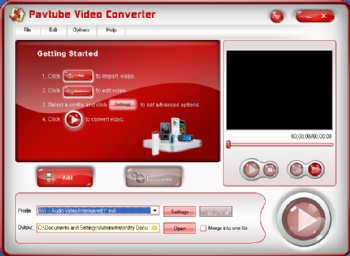
Easy to use, good results: That's the gist of what I have to say about Pavtube Video Converter ($29, free demo). I used this attractive utility to convert several files to iPod and 3gp format. However, it took the installation of the free Xvid and Quicktime codecs before I could use it.

Pavtube states in the system requirements that you must install Quicktime, however, there was no mention of installing Xvid, which the company lists as supported. That's a minor annoyance at most--anything for which you can install a DirectX filter, it seems this program will convert. Performance was more than adequate, though not as speedy as Cyberlink's Power Director, which I usually employ for transcoding. I've already mentioned that Pavtube Video Converter's interface is attractive. It also prominently displays the most common options such as the output profile (iPod, 3GP, WMV, etc.) on the main page which makes it quite quick and easy to use. There are a couple of settings dialogs, but you shouldn't have to access them very often.

If you head to the company's Web site with wallet in hand, beware that there are a number of single-purpose (e.g., to iPod only) cross-coders advertised there that cost exactly the same. Make sure you purchase this all-purpose transcoder, not a one-trick pony, if you decide to buy. The demo version of Pavtube Video Converter watermarks video with a very prominent Pavtube logo, but it gives you a good idea as to its merit.

Google Goes Gaming with New Themes

Google is playing along with the gamer crowd and has unleashed a series of eye-popping video game themes for its iGoogle homepage. Check out the gallery of all 24 themes currently available, pick one, and enjoy the pixilated pleasures provided. Or, if you love 'em all and can't make up your mind, use the game of the day option and automatically change your backdrop every 24 hours.

Like Google's Artist Themes, the header of the page changes as the day progresses, giving you two or three different banners to enjoy. The video game theme evolves this by providing a picturesque background as well, contrasting all the apps and widgets you've added.

The themes, meant to reflect your nerdier interests, include popular titles such as Zelda, Tomb Raider, World of Warcraft, Scrabble, Super Mario Bros. and many more. Google even has a theme for Mass Effect 2, the highly anticipated sequel to 2008's popular but panned original.

iGoogle has undergone a series of changes since launch, some of which haven't been popular. But who's gonna argue with a Street Fighter?

Report: Skype for iPhone May Launch Next Week

Skype may launch a version of its mobile Voice-over-IP (VoIP) and instant messaging service as early as next week, according to a report from Om Malik of GigaOM. If true, the application could prove popular with cost-conscious iPhone users who’d like to save a few bucks by routing calls over AT&T’s data network. Currently, iPhone users must use third-party services like Fring to access Skype.

Skype for iPhone could debut at the CTIA Wireless trade show that begins April 1 in Las Vegas next week, Malik speculates. Industry watchers have anticipated an iPhone version for some time, particularly since the popular service already runs on other mobile devices. In addition to Skype for Windows Mobile and Skype Lite for Java phones, there’s a version for Google Android phones like the T-Mobile G1.

While Skype’s mobile ambitions are good for iPhone users, the VoIP service won’t bring the end of standard voice-call service anytime soon. As PC World’s Liane Cassavoy reports in a recent review of four mobile VoIP apps -- EQO, Skuku, Skype for Windows Mobile, and Truphone -- mobile VoIP call quality isn’t quite there yet, and the cost savings aren’t that great.

“Most notably, the call quality remains iffy at best, and in some instances it's absolutely abominable. Also, depending on your calling habits, you may not see any savings at all. Most services still charge a per-minute rate, so you'll save on domestic calls only if you've exceeded your regular voice plan's allotment (in which case you might still be better off upgrading your voice plan).”

Cassavoy does point out, however, that international callers can save big bucks by using a mobile VoIP service.

While Skype for iPhone may not offer immediate benefits for everyone, the service has plenty of potential in the near future. If the next-gen iPhone, which may appear as early sometime this summer, includes video capture, Skype could turn the iPhone into a portable video conferencing device. That may not happen immediately, of course, but AT&T’s upcoming 4G Long-Term Evolution (LTE) broadband network, slated to debut in 2011, could very well have bandwidth necessary to make two-way, real-time video a popular app, particularly among business users.

Apple WWDC Dates Announced: Rumors Abound

Apple Announces WWDC Dates and Rumors fly
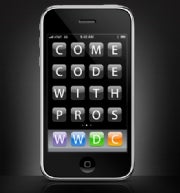
Apple announced June 8-12 as its date for this year's Worldwide Developers Conference at San Francisco's Moscone Center West. With the date confirmed, we turn towards the rumor mill surrounding what becomes the most anticipated date for Apple Fanboys in 2009 now that Apple decided to bow out of MacWorld. Apple says this year's WWDC will be all about the Mac OS X and the iPhone. But really, who knows what who or what will actually show up on stage? There are already piles of speculation and rumor out there, so let's dive in!

Return of the King?

Steve Jobs has been out of the public eye since he said he was taking time off for health reasons. At the time of his announcement, Jobs said he would be back in late June, but Apple loves surprises, so who knows? There's no doubt that a Jobs appearance at WWDC would invigorate the Apple-loving masses. However, Silicon Valley Insider's Dan Frommer wonders if Jobs will use WWDC to announce his retirement instead. Jobs has apparently stayed out of the loop in planning WWDC '09, or at least he hasn't interacted with Frommer's Apple contacts. It may also make sense for Jobs to ease his way out of Apple in stages since people identify him as the heart and soul of the company. In the end it's all guesswork, but it's worth considering as Apple looks to the future.


Quicktime overhaul

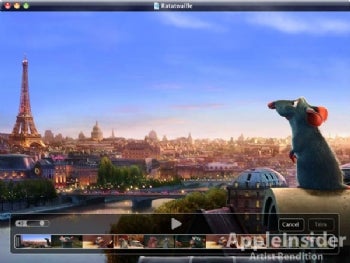
Quicktime is reportedly getting an under-the-hood overhaul, but its look may also change. Apple Insider supplied this mock up, which shows a new Quicktime with "virtual playback controls," presumably to maximize the screen space. Instead of the regular Quicktime window, the controls will appear as a clear glass panel when you mouse over the screen. This is similar to what happens in iTunes when you select full-screen mode.

Mac OS X: Snow Leopard

You may have also noticed from the Quicktime photo that the titlebar was a little darker than usual. That's because Quicktime's new look would be part of a Snow Leopard visual overhaul. When Apple announced Snow Leopard, it was billed as an under-the-hood upgrade to maximize dual core processors and improve overall performance. At the time, there were no announcements about a new look and feel.

However, rumors have been circulating recently that Apple has been working on a new user interface all along. Code-named "marble," some are describing the visual upgrade as "significant." The major change is that OS X may shed its platinum look for a darker chrome visual. Other user interface updates include iTunes-style scrollbars and menu bars with a darker background and lighter text.

The UI updates first started leaking through developers who got their hands on Snow Leopard test builds. Then it was reported that Apple stripped any new visuals out of the latest Snow Leopard test build to halt further leaks. Some are expecting Apple to unveil Snow Leopard at WWDC, and the new OS may even be available for sale this summer.

iPhone OS 3.0

There is, of course, the rumor that new hardware could be announced at WWDC, but speculation around this has dropped off recently. Instead many expect Apple to launch its push notification service announced earlier this month.

What's Next?

Now that WWDC has been officially announced, I'm sure it's only a matter of time before grainy images from China that are supposed to be the latest Mac gadget start popping up. Or perhaps a screenshot of Snow Leopard will be posted on a fanboy forum? It's hard to know where the next rumor will come from, but one thing you can be sure of: the WWDC rumor mill has only just begun.

Friday, March 27, 2009

Ubuntu 9.04 Beta: Quick Look

So far there have been six alpha releases of the forthcoming Ubuntu 9.04, due for final release next month, and late yesterday the one and only beta release was made available for download. From this point forward there's a release candidate in mid-April, before the final release is made on the 23rd.

With this beta release everything should be shaping up nicely, and (theoretically) the work from this point onwards should be bug-fixing and polish.

Let's find out how the release is shaping up.
Performance

One of the things demanded by Ubuntu head honcho Mark Shuttleworth in his announcement of 9.04 was that boot times should be improved. This certainly seems to have happened, and in my tests 9.04 booted pretty quickly. In fact, booting to the login prompt was actually quicker than resuming the machine from hibernation. (My test machine was a crappy budget laptop with a Celeron chip and 1.5GB of memory; I did a full hard disk install.)

Additionally, the ext4 filesystem driver is now included, although isn't used by default, and must be deliberately selected by the user during partitioning. The big boasts of ext4 as far as end-users are concerned include support for insanely large file systems of up to one exabyte, but the feature that's got most people excited is a performance boost compared to the older ext3. I ran some quick and unscientific tests on an ext3 installation of Ubuntu, and then repeated the tests of an ext4 install. The testbed was the aforementioned budget laptop, and the highly-accurate timing device was myself, my thumb, and the stopwatch mode of my wristwatch. In other words, don't hold too much store by these results.

There were some marginal improvements with ext4, especially in boot times and when copying significant amounts of files, but perhaps not enough to overcome the potential risks of using ext4 this early in its life. (You might be wondering if the hibernate to disk performance is improved but remember that Ubuntu hibernates to the swap partition, not the filesystem, so this is unaffected; I realized this after performing my tests, but it was borne out in my results which were virtually identical between filesystems).
Ext3

Boot from cold: 25.93 seconds
Start Firefox on a cold machine: 4.64 seconds
Start OO.org Writer on a cold machine: 7.11 seconds
Copy /usr directory to the desktop (1.5GB; using cp command): 6 minutes, 6.62 seconds
Hibernate to disk: 29.21 seconds
Hibernate wake-up from cold: 30.86
Ext4

Boot from cold: 22.23 seconds
Start Firefox on a cold machine: 4.35 seconds
Start OO.org Writer on a cold machine: 7.74 seconds
Copy /usr directory to the desktop (1.5GB; using cp command): 5 minutes, 21.48 seconds
Hibernate to disk: 29.56 seconds
Hibernate wake-up from cold: 29.91 seconds

Any Windows fans out there will be pleased to hear that ext4 includes an online defragmentation tool, e4defrag. However, this doesn't appear to be installed on Ubuntu 9.04 (or perhaps it resides under a different command-name; if you know the situation, post a comment below.)
Visual Refresh

There's a new boot progress graphic (i.e. usplash), which I can't say looks better or worse than previous efforts. Additionally, there's a new wallpaper that takes as a starting point the swirly lines seen in virtually every operating system wallpaper since 1998. The only different here is that the color scheme is orange and brown, in the usual Ubuntu style. My advice: install the gnome-backgrounds package, which includes a terrific sample of images.

Some of the community themes that were optional in 8.10 are now default (Dust, Dust Sand, New Wave), and this helps mitigate the fact that the whole Ubuntu desktop experience is starting to stagnate. It hasn't changed significantly for quite a few years now.

It's now possible to set transparency effects for the panels, provided the Compiz visual effects system is activated (it is by default). This is kinda cool, and brings Ubuntu into line with OS X Leopard, which introduced a similar feature.

The Log Off/Shutdown etc. items have been removed from the System menu, and now live on the fast user switcher icon at the top right of the desktop. This icon is turning into something of a status display and mode-switcher--not only does it now let you log out etc., and switch to a different user account, but it also shows your Pidgin status. Rather annoyingly, the fact it is now the only way to shutdown means that you can't get rid of it, unless you intend to use telinit each time at the prompt.
Notifications

The last few releases Ubuntu have featured notification bubbles that pop-up near the system tray area at the top right of the screen. These inform the user about events that have happened, such as connecting to a wireless network.

With 9.04 the notification system has been visually overhauled so that the pop-up boxes have a smoked glass appearance. All notifications now appear as pop-up boxes in this style, including notebook screen brightness status displays, for example, or low battery warnings. If more than one notification appears at the same time, they stack-up beneath each other.

Unfortunately, the notifications don't work like those on other systems, whereby you can click on them to clear them. Put your mouse over the notifications on 9.04 and they turn semi-invisible, letting you click beneath them. They only go away when they want to, which seems to be after a couple of seconds by default. This is a little annoying.
OpenOffice.org 3

Although it was skipped for the 8.10 release last year, despite being available (the omission was caused by problems with packaging, apparently), OpenOffice.org 3 has made it into the 9.04 release.

To be blunt, this is very hard to get excited about. There's a handful of cool new features, including inline commenting, which as an author I find useful. If you want to know more, see the OpenOffice.org Web site.
Synaptic

Synaptic now features a "Get Screenshot" button in each package description that will, as you might expect, download a thumbnail screenshot of the application (provided it's the type of application that it's feasible to have a screenshot of; system components don't have them, for example). Clicking the thumbnail will then download the full-resolution version. This is a nice feature.
Gnome 2.26

It has to be said that Gnome is maturing into a very nice desktop environment, and the 2.26 release sees only minor tweaks here and there. Sadly, many of the key features boasted about on the Gnome Web site are skipped in the Ubuntu distribution of Gnome. You won't see the Empathy Instant Messenger, for example, unless you specifically install it. On the other hand, Ubuntu's IM choice of Pidgin is better right now, so this is a good thing. Evolution sees a few new additions, primarily in the area of Windows integration, although missing from Ubuntu's Gnome distribution is the all-new ability to import Microsoft Outlook PST files (the central database of messages). This seems to be because the libpst library is missing, but I haven't investigated any further. Still, this is a shame.
Cruft Cleaning

One of the features slated for 8.10, but postponed until 9.04, is the Computer Janitor program. This lives on the System, Administration menu. Unfortunately, it doesn't work in the beta, complaining that a package is missing, but I played with it in the alpha releases I've tested. It's purpose is to get rid of old packages, such as old kernel files that stick around when you upgrade. As far as I can tell, it's a GUI equivalent of typing sudo apt-get autoremove and sudo apt-get clean at the command-prompt. Beware, however, that it might be a little overzealous: in one of my tests using the alpha release, it considered no longer necessary a package I'd installed by hand (TrueCrypt). I had a little too much faith in it, and agreed to its deletion, only to have to reinstall the package afterwards.
Brasero

Technically Brasero should be discussed under the Gnome 2.26 heading, because the program is officially part of the Gnome desktop experience. And like Gnome itself, Brasero is maturing quite nicely. The big change in Ubuntu 9.04 is that it has entirely replaced Gnome's built-in CD/DVD Creator, that formerly lived on the Places menu. In this beta release, there are two menu entries for Brasero on the Applications menu: one under Sound & Video, which starts the full Brasero interface, and one under the System Tools menu, that starts Nautilus in CD/DVD recorder mode. When the Write To Disc button is hit, after you've dragged across the files you want to burn, Nautilus hands over to Brasero to actually create the disc.
Conclusion

In his announcement of the 9.04 release, Mark Shuttleworth only laid down two demands that were of interest as far as end-users were concerned: faster booting and integration with web apps. The first nail has been squarely hit on the head, but the second seems to have been entirely ignored. Firefox doesn't have Google Gears installed, for example, and the interesting Prism project, that "wraps" online applications to make them appear like local apps, hasn't been integrated.

It doesn’t even appear that the version of Firefox supplied is the exciting new 3.1 release--the version number supplied with the beta is 3.0.7 (although admittedly 3.1 is still in beta). Personally, I believe that online applications are going to become more and more important in future, so I'm disappointed that Ubuntu isn't making any progress in this direction. There’s a real chance to make a stake on virgin ground here, and it’s land that Microsoft and Apple don’t even know exist yet. Still, here's hoping for the Ubuntu 9.10 release in October. (Until then, anybody wholly committed to the online application experience can use gOS, which takes Ubuntu and adds-in exactly what Shuttleworth requested.)

Should you upgrade to Ubuntu 9.04 when it's released? To be honest, I don't see any reason not too. But I also have trouble of thinking of reasons why you should. With each new release of Ubuntu, it’s becoming harder and harder for me to make a genuine recommendation, and this is something that worries me. The only compelling reason I can think of making the upgrade to 9.04 is the faster boot times, and the possibility of experimenting with ext4 file systems. Other than that, you're perhaps better sticking with 8.10, or even the 8.04 LTS release, which despite being a year old, remains a strong and stable release that's perfect for most users. With the recent raft of bug fixes, it just gets better and better. I use 8.04 LTS on most of my computers.

Why Microsoft Should Buy Facebook

Facebook is in trouble and Microsoft can solve those troubles, at least for now, by taking over the company. Yes, it is hard to believe that a company growing as rapidly as Facebook is growing should be in trouble, but it is.

No matter how Facebook tries to position itself to earn its living someday, it runs afoul of its users. Thus, Facebook is a classic example of a company that loses money on every sale, but "makes it up in volume."

The things Facebook must do to turn itself into the big moneymaker that venture capital funding demands will, I predict, turn it into just another MySpace clone--in the sense that MySpace is run for the benefit of advertisers, not its users. Which is why many adults who started on MySpace moved to Facebook in the first place.

Facebook already has credibility problems stemming from the types of advertisers it mostly attracts. How is it that every Facebook ad seems to be promoting a dubious scheme of some sort?

Microsoft does not need for Facebook the make the huge profits its current financing requires. Microsoft could buy Facebook and just run nice, low-impact Microsoft advertising and do just fine. Alternatively, it could accept advertisers very selectively and, over time, create an environment that users might actually accept.

This is a case where I trust Microsoft, in its kludgey "be all things to all people" way, to do a better job of looking after me than a bunch of Facebook folks still infected with start-up fever and expecting Googlesque returns.

If you just take the pressure off Facebook management to quickly turn the service into a big money maker, I think they will ultimately find a way to make it an even larger profit center (for Microsoft), without losing perhaps half to three-quarters of the Facebook user base in the process.

The problem with Facebook as it currently exists is that it was not designed, from the start, to be a favorable environment for advertisers. Rather the opposite. Facebook was until recently so customer-focused that it developed a wonderful user interface that left little space for advertising or other ways to earn a buck.

Changing Facebook to make it more ad-friendly is what has its customers so upset. Each of the big Facebook conflagrations has been somehow ad related: First, ad beacons; next terms of service; post recently, the new layout. I am sure the Twitterization of Facebook falls in there somewhere. Twitter on Facebook is pretty disgusting to look at.

I repeat: If I want Twitter, I already have it. I liked (in the past-tense) Facebook precisely because it wasn't Twitter.

The recent discussion on Facebook's blog about changes to the user interface does not seem to be aimed at solving these problems. To my reading, they are just dressed-up explanations of what Facebook was planning to do anyway.

It may not look like it, but even as it experiences huge growth, the Facebook many of us know and loved (past-tense, again) is in deep trouble. Microsoft can do itself and us a favor by purchasing Facebook and giving it a chance to be the user-friendly and profitable company I know it can become.

David Coursey loved (past-tense) Facebook and hopes to someday love it once more. Write him using the comment form at www.coursey.com/contact.

Facebook Caves To User Outrage and Google Adds Semantic Search On PC World Podcast Episode 22

This week, PC World Editors Robert Strohmeyer, Tim Moynihan and Mark Sullivan bring you the 22nd episode of the PC World Podcast. This edition is a lively discussion about the aftermath of Facebook’s most recent facelift, Google's new semantic search, and the new Webbie HD camera.

Facebook recently completely redesigned their Web site, giving it a noticeably Twitter-esque vibe. The changes were so drastic that users complained, and Facebook decided to make some alterations on the new design--but will they really benefit the user? The group weighs in.

It may not seem revolutionary now, but Google will soon be redefining the way we search for information online with the use of semantic search technology. After the drastic introduction of Facebook's changes, will the switch to Google semantic search will be more subtle and gradual?

Tim Moynihan gives us an early look at the new Webbie HD, the latest version of a reasonably priced camcorder created for the You Tube generation. It’s small and attractive--but is it going to suit anyone beyond the target market of teenagers?

Finally, our editors debate this week's Big Question: Has Twitter jumped the shark?

Asus Portable To Have Optical Drive: Is It Still A Netbook?

Taiwan's AsusTek Computer has played a major role in defining the netbook computer genre. Its Asus Eee models, along with competing mini-notebooks such as the Acer Aspire ONE and Lenovo Ideapad, have proven popular with consumers willing to sacrifice a few features -- full-size keyboard, larger screen, and a DVD drive, to name a few -- for a smaller, lighter portable that’s fine for email and Web-browsing.

But Asus will soon break with netbook tradition by launching an Eee PC with a built-in optical disc drive (ODD). According to a DigiTimes report out of Taipei, the ODD-equipped E1004DN netbook will arrive next month, followed by the 1008HA in May. The E1004DN will feature an Intel Atom N280 processor, a GN40 chipset, and a 120GB hard drive. There’s no word yet on screen size, but given that Asus has already announced plans to discontinue its 7-inch and 8.9-inch Eee netbooks, it’s a safe bet the E1004DN’s screen will measure at least 10 inches. The E1004DN will retail for about $531 to $590, although I suspect street prices here may be a bit lower. The $600-range seems a bit high for value-oriented netbook buyers.

But does the netbook crowd really want a built-in optical drive? Asus certainly thinks so, and it’s made some pretty smart moves thus far. Netbooks are popular with air travelers, many of whom watch DVDs during flights. For them, particularly those who aren’t fond of digital downloads, an optical drive makes sense.

With netbook screens growing larger, and with mini-notes adding new capabilities such as optical drives and the ability to play high-definition video, maybe we need a new definition for the genre. What exactly is a netbook? A portable with a screen that’s, say, smaller than 13 inches? A computer that uses the Intel Atom CPU? A notebook that’s priced under $500? Ultimately, the term “netbook” may disappear altogether, like “LCD display.”

A Geek's Guide to the Earth Hour Challenge

World Wildlife Fund is promoting a hour of darkness - what's a geek to do?The World Wildlife Fund wants you to power down your electronic life for one full hour this weekend: no lights, no TVs, no computers -- basically, nothing that actively uses electricity. Think you're up for the Earth Hour challenge?

Earth Hour: What It's All About

Earth Hour is scheduled for 8:30 to 9:30 p.m. in your local time zone this Saturday, March 28. The goal is send a message to governments everywhere that more should be done to combat climate change. Leaving your lights on, the WWF says, is a "vote for global warming." (Not that they're trying to guilt you into participating or anything...)

The WWF is hoping a billion people worldwide will make the switch. The results of the hour will be presented at a Global Climate Change Conference later this year.

How to Survive the Powerless Hour

So, a full hour with no electricity -- a daunting idea, isn't it? (If you really have doubt as to the level of your electronics addiction, take this digital astrology quiz to see just how dependent you are.)

Now, to be fair, the official Earth Hour site talks about spending the hour making a video, taking and uploading photos, live-blogging, or tweeting away on Twitter. And sure, even with the lights off, you could technically still bask in the glow of a battery-powered cell phone or laptop as you connect with virtual friends across the world.

But come on -- that's a questionable loophole if I've ever seen one. You did use electricity to charge the things, after all. Plus, there has to be a router connected somewhere that's giving you all that delicious Wi-Fi, right? Leaving devices on seems to be missing the spirit of the whole "cut the cord" concept. Hey, the makers of BlackBerry agree, so I can't be too far out on a limb here.

Anyway, as attached as we've all become to our inboxes, taking an hour on a Saturday night to be in the dark might be good for more than just the environment. Imagine it: no ringtones sounding, no text messages buzzing, no electronic interruptions whatsoever. I can certainly think of one thing you could do with the moonlit quiet time.

Just make sure you have protection. You don't want to be building a computer outside without some way to safely ground yourself.

Asus Takes Top Spot In Reliability Report

RESCUECOM, which recently increased from annual to quarterly data reporting, provided its latest Computer Reliability Report for the fourth quarter of 2008. ASUS landed the top spot followed by Lenovo and Apple. Here are the scores from the report:

* ASUS - 972
* Lenovo - 348
* Apple - 324
* Toshiba - 172
* Acer - 151
* HP - 142

The analysis compares vendor market share with consumer service calls placed to RESCUECOM's call center. Scores are calculated based on a sample of 15,000 calls received during the quarter. In addition, the report reveals quality of the components and software used in manufacturing the computer as well as support the company provides to its customer after the sale.

"The results are in, and although ASUS is the leader this quarter with a reliability score of 972, ASUS's reliability score should be taken with a grain of salt, even though it was more than 600 points ahead of IBM/LENOVO. We look forward to seeing if ASUS is able to maintain the same demand and reliability over the coming quarters," says David Milman, RESCUECOM CEO.

Microsoft Hits Apple Where it Hurts

Video: Laptop Hunters $1000 – Lauren Gets an HP Pavilion

Faster than you can say Red State vs. Blue State, Microsoft's latest ad has set off a class war between Windows and Mac fanboys. If you haven't seen the ad, basically, shopper Lauren tries to find a laptop under $1000 and ends up getting a Windows machine.

Artwork: Chip Taylor
I remember reading earlier this year a comment by Ed Oswald on Technologizer that said Microsoft fans were "much more metered in their support" compared to Apple fans. Oh, how times change! In the past, Windows boys have let Microsoft do all their public dissing for them, taking shots at the Apple Tax, shortcomings of the iPhone and even the Apple logo. But since Microsoft pulled out the long knives with its latest commercial spot, warriors of both stripes are reaching out from their basement caves for an epic Windows vs. Apple battle.

"Only the Apple people... can be called 'fanboys,'" a commenter named Lonewaffle said on PC World. "Whereas all 'PC' people are just reasonable and more intelligent." The conversation continued in much the same way, with most cracks going after Apple-when they weren't being directed at the author that is.

As the battle waged it seemed we were doomed to witness further carnage. But then a glimmer of hope named YukonJack stepped in to calm the warring tribes, "This is an age old battle between "styles" in the old days before computers: there was and [probably] still is a battle going on somewhere between a Harley-Davidson owner and an Indian owner." Ah, yes, tell us, Yukon Jack, how this is such a silly argument with a sentimental anecdote from the annals of Americana: "The difference between them was the Indian owner had actually gone to school. Does this sound familiar?" Turns out YukonJack is a Windows man.

PC World wasn't the only place that fights broke out. Over at Gizmodo the Apple fans were defending their honor against Microsoft's attack. Even poor, perky Lauren became a target in this bloody battle of words. "I don't care if that broke b*tch can't afford a Mac," said pettiblay. "I would love to see a study where you give a couple people 2500$ and see which laptop they buy."

On Crunch Gear, IHateMyIphone said, "most mac users only went with an apple because some over paid actor pop up on their tv with a cool shirt on and started bashing vista."

Of course it wasn't only the commenting crowd that was getting in on the action. Over at Microsoft Watch, Joe Wilcox said, "Oh, baby, this is exactly the kind of marketing Microsoft should be doing now. The emphasis is value, with Apple taking blows from Microsoft. Ouch." Apple Insider, on the other hand, went after Microsoft with the price vs. value argument. Can you guess what its conclusion was?

We can expect more of these ads, as advertising dollars are flowing right now to get Lauren and her fellow shoppers in front of the March Madness audience. So with no end in sight, and since no one else is willing to be the voice of reason, let me bring some sanity to this process. Buy whichever system you like. Just make sure it meets your needs and you're getting good value for your money.

Do you understand what I'm saying? That's right, you should switch to Linux.


YouTube Gives Twitter Love

twitter google youtubeGoogle sprinkled a few extra features on YouTube last night, in a spring cleaning effort to catch up with the ever-popular Twitter. Viewers can now post a video they like on Twitter and users got a few tweaks when managing their content.

Everybody is integrating Twitter functionality these days, as the microblogging platform gains more user traction. The most prominent example is Facebook, which redesigned its whole news feed to accommodate the need for real-time updates. And now it's YouTube's turn, but with not so much glory.

The share links on YouTube now offer a Twitter posting option along Facebook and MySpace. Users can expand the box for more sharing options, but those three xare the ones YouTube promotes.

When you click on the Twitter button, a pop-up window will open your Twitter account and fill in automatically with text asking your followers to "check this video out" followed by the video's title and URL. Unfortunately, the video link is not shortened (using services like TinityURL or Bit.ly) but YouTube said it plans to add that "down the road."

Other improvements made their way onto YouTube as well. A new Flash uploader is in service, together with a long-expected upload progress bar. The site also promises an estimated video processing time after the upload in the near future. An official HD USL parameter has been added also, for sharing HD video links.

And when YouTube says "spring cleaning," it really means it: the video-watching pages are also tidied up, with smaller action links and no more tabs for comments, statistics and data (they are now collapsible using a little arrow). It is now easier to log in with Google Account credentials (if you Google and YouTube accounts are associated) with an all-in-one sign-in page.

YouTube also makes an attempt to take on Apple's iTunesU, with the YouTube EDU project, which collects and highlights educational content uploaded by colleges and universities on the site.

Wednesday, March 25, 2009

Symantec Says Credit Card Data May Have Leaked From India

Symantec said on Monday that credit card information relating to three of its customers may have been leaked from its call center contractor in India.

The company has narrowed down on one employee of the contractor as a possible suspect, and has turned over the information including recorded call data to the police for investigation, a spokesman for Symantec India said on Monday.

The call center, e4e India, however denies any theft of data from its operations.

Reporters from the British Broadcasting Corporation (BBC) posing as fraudsters claimed last week in a BBC report that they bought names, addresses and valid credit card details of persons from the UK from a man they identified as Saurabh Sachar in Delhi.

Three of the persons whose details were provided to the undercover reporters had bought software from Symantec by giving their credit card details to a call center over the phone, BBC said.

Symantec discontinued routing of online sales and other calls to the service provider, as soon as the matter came to its attention, the spokesman said.

Symantec was planning to discontinue its relationship with e4e by the end of this month for commercial reasons, but has decided to expedite the transition in view of the suspicion of information theft from the call center, the spokesman said. It didn't have any problems previously with the call center, he added.

E4e however said that there was no evidence whatsoever linking its operations to the data leakage at Symantec alleged by the BBC report. The company is just one of many call centers in India to which Symantec outsources work, said Narasingarao Dataram, president of e4e India, on Monday.

On hearing of the BBC report that data from Symantec customers may have been compromised, e4e did an internal check, and also alerted the cyber-crime police, only out of due diligence, and not because it believed that the data had been leaked from the its operations, Dataram said.

Did Lenovo Invent Apple's Netbook?

In Silicon Valley's clash of innovation and ego, it's hard to remember who invented what. Oftentimes a company invents something it's not ready to ship. Another company ships something it didn't invent. Both companies jockey for the credit.

The iPhone is a perfect example. Back in 2006, it became clear that several handset makers were ready to embrace a new idea for cell phones. Instead of devices with small screens and numeric or alphabetic keypads, these companies planned to ship cell phones that were all screen and no keypad. The buttons would be mere software pressed on-screen.

Apple Inc. was one of those companies, but its product would be beat to market by handsets from Asian manufacturers. So Apple did something unusual. CEO Steve Jobs fully unveiled the iPhone in January 2007, nearly six months before it would ship. The resulting hype suffocated awareness of the Asian handsets.

Now everybody associates all-screen, touch-screen cell phones with Apple and the iPhone. Most casual observers assume Apple invented that type of device, and that everyone else is copying the iPhone.

Here comes the ultimate netbook

In the run-up to Apple's big iPhone 3.0 announcement this week, rumors about an Apple netbook reached fever pitch. Would the company ship one? If so, would it be a clamshell or a tablet? Would it run Mac OS or the iPhone operating system?

Some rumor-mongers speculated about a midyear launch, but others suggested that Apple would employ the old "one more thing" shtick to surprise the industry with its new netbook during this week's iPhone 3.0 rollout. It didn't happen, but many thought it would.

During this frenzy of speculation, photos "leaked" of a truly breathtaking netbook from Lenovo Group Ltd., the Chinese company that acquired the ThinkPad division of IBM.

Initially, the Lenovo netbook, called the Pocket Yoga, was reported as a soon-to-be-shipping product. Then it emerged (on my blog, among other places) that the Pocket Yoga was nothing more than a two-year-old concept that Lenovo had no plans to build.

Dual-Screen Laptops from Lenovo and Fujitsu


http://images.pcworld.com/reviews/graphics/products/imported/43909_g3.jpg

http://images.pcworld.com/reviews/graphics/products/imported/43909_g1.jpg

Motorola and Kodak deliver a phone with an impressive camera, but uninspired design.

http://images.pcworld.com/reviews/graphics/products/imported/43909_g2.jpg

The Motorola Motozine ZN5 is part cell phone, part digital camera. It's the brainchild of a partnership between Motorola and Kodak, boasting a 5-megapixel camera with a bevy of impressive settings and features. And at $99 (after a $100 mail-in rebate) it comes at an unbeatable price--it's much less expensive than the Nokia N95 (approximately $500, unlocked), which also has a 5-megapixel camera. But Motorola put so much effort into the camera component that it compromised on other aspects of the phone, such as design and 3G support.

Face up, the Motozine ZN5 is a typical candy-bar-shaped phone. It has a bright, 2.4-inch, 320-by-240-pixel screen, and beneath that lies a flat keypad (with small, tactile bumps on the number keys). The handset also has dedicated keys for different camera functions, such as photo reviewing and sharing.

Flip the ZN5 over, and it looks like a stand-alone point-and-shoot camera, complete with a Xenon flash and lens cover. Unfortunately the lens cover is flimsy and easily pops up in a bag or pocket.

Either way you turn it, the ZN5 still resembles a slab of concrete. In spite of that, however, it feels good in the hand, both as a camera and as a phone. Weighing about 4 ounces, the ZN5 is sturdy without being too bulky, and it's constructed with a combination of hard and soft plastic that makes it comfortable to hold for long periods of time.

And you'll want to hang on to this phone for every photo opportunity, because the camera, the ZN5's headline feature, is superb. It starts automatically when you slide open the lens cover or when you press the dedicated camera key on the phone's side. The 5-megapixel camera has autozoom, a low-light setting, three focus settings (auto, landscape, and macro), five white-balance settings, panoramic and multishot modes, an autotimer, and six shutter sounds.

The camera has some limitations; for one, you can't manually adjust the shutter speed or set the aperture. The click-to-capture speed is about 0.02 seconds, though, which is faster than most mobile phones and even some stand-alone cameras. The camera automatically adjusts aperture and shutter speed depending on the environmental lighting.

After you're done snapping pictures, you can edit your photos on the camera. Among other things, you can resize, rotate, or crop; adjust brightness, contrast, or sharpness; and add image borders and graphics. Kodak's Perfect Touch feature--a one-touch photo enhancer that lightens dark areas and deepens colors--is another useful included editing tool. Unfortunately, you can't edit your recorded videos; you can only trim their length for video messages.

When you've edited your photos to your liking, you can transfer them to your PC with the included USB cable or 1GB microSD card, or via text message. You can also upload them wirelessly to the Kodak Photo Gallery, where you can share the pics and order prints.

In my hands-on tests, photo quality was very good, about the best I've seen from a mobile phone. Colors appeared accurate and bright, with very little interference. The Xenon flash was a little too bright, however, often blowing out my pictures. Videos weren't as crisp, but still looked good. The ZN5 has a panorama mode, too. When I first heard about it at CTIA, I thought it seemed a bit gimmicky and useless. But in actuality, I really enjoyed playing with this feature, and I had fun taking action shots with it.

The ZN5 connects over T-Mobile's EDGE quad-band network, but also supports Wi-Fi. The browser loaded pages at a moderate speed and displayed them clearly, but with limited Java support. The ZN5 definitely could benefit from a faster 3G connection, particularly for the photo-uploading features. Connecting through Wi-Fi didn't really increase the speed.

Call quality, enhanced by Motorola's CrystalTalk technology, was very good. My contacts sounded clear, though a little quiet. Parties on the other end consistently reported very good sound quality with little background noise. The battery lasted 10 hours in our lab tests--the maximum amount of time that we test.

The ZN5 has the standard Moto media player, which supports WMA, MP3, and AAC, plus a few other types of audio files. Unlike other Motorola phones, such as the Rokr E8, the ZN5 does not support protected AAC from the iTunes store. The media player is pretty bare-bones: You can browse your music by recently played, artists, albums, genres, and composers. The ZN5 offers no music-store app, but you can sync your music library on your PC to your phone via Windows Media Player 11. The handset also includes an FM radio, which triggers when you plug in the included headphones. If you prefer, you can swap those headphones for better ones, since the ZN5 has a standard 3.5mm jack.

Audio quality for the most part was good but not stellar. Video quality, on the other hand, was worse than I expected; I saw a lot of blurriness and interference in the videos I played in my hands-on tests.

The Motorola Motozine ZN5 might not be the most eye-catching handset or the fastest phone around, but its impressive camera makes those small faults forgivable. And you can't beat the $100 price.

Tuesday, March 24, 2009

GDC 09: Sony Slashes PS3 Price (Sort Of), PC Tops for Gaming

Mar 25, 2009 12:42 am

The best parts of GDC are the ones you'd probably find the most boring. They're spent hunkered in crowded, slightly gamy smelling rooms listening to panels of game celebs wax prolific about anything from high-definition physics and platform-independent shader development to tongue-tanglers like "Riding the Waves of Change: How Video Game Companies Can Flourish in an Environment of Relentless Volatility and Flux."

And then you get headline-grabbers like these...

Sony Cuts PS3 from $10,250 to $2,000. The debugging Reference Tool, that is. Yeah, $10,250 mazuma for one of those bad boys. Not to be confused with the debug units we in the press use to access non-retail review discs, these things look like brick houses (see pic at top) or the sidewise desktops we used to prop our CRTs on. The new ones apparently look just like regular PS3s. The reason that drop's important, is that it's essentially Sony dialing the air with one finger and silently mouthing the words "Call me."

Microsoft claims Final Fantasy XIII will sell better on Xbox 360. Yeah, well, claims are free, but results cost in cachet. Microsoft knows no better than you or I or anyone else what the multi-platform performance of a game like Final Fantasy XIII is going to be. To claim (confidently) otherwise is either evidence of hubris, paranormal superpowers, or — you smelled it — marketing. With Capcom's Street Fighter IV selling nearly as well last month on the PS3 as the 360 despite the 360's nearly double unit footprint in the U.S., MIcrosoft ought to be a trifle more cautious. In fact what the company ought to be talking about is what it's going to offer along with Final Fantasy XIII to make an Xbox 360 purchase more compelling. Unique DLC? Themes? Avatar accessories? Time-exclusive demos? Developer interview clips? Come on guys, competition on the field of services, not hyperbole.

The PC Gaming Alliance releases a report stating that the PC is the "No. 1 platform for gaming world wide." No arguments here, though how your arrive at that number is partially a question of how you define the term "game." If you're counting freebies like solitaire and minesweeper and not restricting your benchmark to revenue, the only way the champ could ever not be the PC would be the total implosion of Microsoft Windows...which has roughly as much chance of happening as confirmation of aliens among us. That said, according to the PCGA report, "the PC is the largest single platform for games with annual worldwide revenue of about $11 billion." That's more than any competitor, be it the PlayStation 3, Xbox 360, or...yes, even the Nintendo Wii. I've got the report in hand — it's full of all sorts of fun facts — and I'll be back to say more about this shortly.

Peek Pronto Offers E-Mail on the Go

Capitalizing on the less-is-more model, Peek has introduced its latest email-only mobile device, the Peek Pronto. Coming in at just under $80, the Pronto features push e-mail, SMS capability, Exchange support, and access to five different e-mail accounts. You can also view PDFs, Microsoft Word documents, images, and search your e-mail. The Pronto comes with an unlimited data plan for $19.95 per month, and Peek says the Pronto is 50 percent faster than its predecessor.

The original Peek device gained popularity for delivering a basic e-mail service and nothing else. The Pronto builds on that concept by improving its e-mail experience while not expanding the device's capabilities beyond email. It's interesting that Peek is focused on delivering a no-frills e-mail device in an era when most tech companies are trying to cram as many functions as possible into one device.

Given the wide range of capabilities on today's smartphones and netbooks the Pronto seems a little primitive; however, in these uncertain economic times a moderately priced device that gets the job done could attract a strong following. "Peek Pronto gives you...great value and [that] is exactly what folks are looking for during these challenging economic times," Peek's CEO Amol Sarva said in a statement.

The Pronto has 8 MB of user storage, comes in charcoal gray only, weighs less than 4 ounces, and has 4 to 5 days of battery life under normal usage, according to Peek. If you want to get your hands on the Pronto you can get it online at Amazon.com starting Wednesday, and the Peek will be available at Radio Shack and www.GetPeek.com in April.

Solid-State-Drives: The Fastest Storage Eve... Wait a Second

It only took the site 31 pages to do so, but AnandTech has come out with a thorough, yet easy-to-ready primer on the history and architecture of the modern solid-state drive. But this isn't just a digital textbook: The site has crunched the numbers to determine the veracity of the reports that SSDs aren't as speedy in real-world use as typical benchmarks and evaluations might have you believe.

Here's the deal: A number of print and Web publications run benchmarks on solid-state drives just like they do on standard, magnetic storage. This typically entails firing up a few synthetic benchmark applications--programs that offer speed measurements for a drive, but do so in a fashion that isn't very correlated to real-world use--alongside a few closer-to-real-world benchmarks like PCMark, Iometer, or some kind of measurement from actual applications and games.

These tests are frequently done on blanked (if not unpartitioned) drives, but measured across the whole of the drive as much as possible. By that, I mean that a number of the synthetic benchmarks concoct average speed scores for the hard drive's various operations by measuring its performance from a number of different locations across the drive's spinning platters. Reviewers can't just slap a blank drive in a system, load up a copy of an operating system, and run tests in the OS to simulate the drive's real-world use. They would have no way of controlling the exact methods by which the operating system and hard drive store data after the copy, resulting in incomplete points of comparison against other products--or a lack of apples-to-apples testing.

This isn't a critique of testing methods. But it's important to understand this back-story a little bit, because these same methods are frequently used to test solid-state drives as well. The problem with that is that a solid-state drive can show different performance depending on how many of its flash cells are being used. According to AnandTech, a drive that stores some element of data across all of its blocks--the smallest part of a solid-state drive's flash memory that can be written at any given time--will suffer drops in both its read and write performance.

We'll say that again: Once you've filled your SSD with enough data, performance chokes.

How bad does it get? Depending on the drive, you could see drops of tens of megabytes per second in reads to over a third of your drive's available write performance. This translates into real-world performance losses of anywhere from three to fifteen percent--at least, based on the particular batch of drives AnandTech tested. The site still found that its tested SSDs outperformed the best of the magnetic storage offerings, mostly due to their speedier random-access capabilities. That, and the fact that the affected read speeds of solid-state drives are still beyond those of conventional magnetic storage.

As for the takeaway, AnandTech's results bring forth two points to consider. First, the Declaration of SSD Independence: not all solid-state drives are created equal. This should be obvious, but it's worth emphasizing for those new to this storage spectrum. Drives can be optimized for low random access times, high bandwidth, or a combination of both. AnandTech found that those in the first category, like Intel's X-25M and X-25E line of SSDs, tended to fare much better in post-slowdown performance than SSDs optimized for high transfer rates.

Second, AnandTech's findings cement the need for increased accuracy in solid-state reviews. What good is a benchmark result that will vary in wild and dramatic fashions after you've used the drive for a normal period of time? It would be uncouth to point fingers. But you shouldn't trust the results of any reviewer who only runs a cursory series of benchmark runs on an empty drive. Until this SSD slowdown is corrected on a hardware or operating system level, there's just too much of a chance that reported results won't reflect your real-world performance. And given how much you'll be spending for that brand-new SSD, you really should pick up the best device you can afford to buy.