For $4.95 per movie plus $6.95 shipping and handling per order ($8.95 in Hawaii, Alaska and Puerto Rico) Warner will switch your HD DVD discs for Blu Ray copies of the same movie. Warner is accepting trade-ins for 128 titles including "Batman Begins," "I Am Legend," "The Matrix," "Syriana," and "Unforgiven." If your Warner title is not on the Red2Blu list, Warner says that movie will not be eligible for trade-in.
You don't need to send in your discs, but Warner does want the cover art from your DVD with the UPC code intact. Warner is limiting the Red2Blu program to 25 titles per household with only one copy per individual title. This is also a straight-up trade movie for movie with no cross-title trading. So if you were hoping to trade in that copy of Troy for something else or you stocked up on extra copies of Batman Begins you're out of luck. Red2Blu is for U.S. residents only.
The high-definition format war ended just over a year ago, so Warner is a little late with its trade-in scheme. Best Buy and Circuit City had similar programs shortly after Toshiba's HD DVD surrendered to Sony's Blu-ray format by allowing people to trade in their HD DVD players for store credit and gift cards. This is the first trade-in program from a movie studio, but I wouldn't be surprised if the other studios come out with their own trade-in plans over the next few months.
Apple's App Store for iPhone and iPod Touch has served its one-billionth application, only nine months after the store opened. Last night Apple celebrated the milestone on its Web site, thanking customers for their support. The lucky App Store patron who downloaded the one billionth app will win a barrel of Apple loot from company. Apple also took the opportunity to brag about its success in the mobile ad marketplace and for driving massive amount of mobile Net traffic.
Apple started the official countdown two weeks ago to its one billionth app served. The company hasn't announced who downloaded the billionth app yet. That person will win $10,000 in iTunes credit, a 17-inch MacBook Pro, a 32GB iPod touch, and an Apple Time Capsule.
UPDATE: Apple just revealed that the winner of its billion app download contest is Connor Mulcahey from Weston, Connecticut. The 13 year-old downloaded the billionth app called Bump, a tool for swapping information such as contact details and photos.
More than 37 million devices are running Apple's mobile operating system: more than 21 million iPhones and more than 15 million iPod touches (with some 35,000 apps available in the store) according to the company. Besides driving the success of the App Store, these devices also helped Apple control 50 percent of the mobile ad market and drive the most mobile OS Internet traffic in the U.S., according to the latest market reports.
AdMob's research shows that the iPhone and iPod touch serve around 50 percent of the mobile ad requests in the U.S., followed by Research In Motion with 22 percent and Windows Mobile with 11 percent. Worldwide, Apple's handsets go neck-to-neck with Nokia's when it comes to traffic generated by smartphones. AdMob's data shows that Apple's devices drive the most traffic world wide, counting in at 38 percent.
However, despite its overall success, Apple's App store is not flawless. This week the company has come under criticism after releasing and the retracting an application which was considered by many offensive and unethical (read full story). Apple's selection process for application approval in its store also has a history of banned applications, leaving many developers unhappy with the company's decisions.
RealNetworks and Hollywood studios are squaring off today in a U.S. District Court in San Francisco where Judge Marilyn Hall Patel will determine if the program RealDVD violates laws created to prevent the copying of DVDs that use digital-rights-management technology. RealDVD is a $30 software program that allowed you to copy DVDs onto your computer. Last year a judge halted the sale of the program.
RealNetworks maintains its RealDVD software is a convenience to consumers who can copy DVDs to a laptop for easy disc-free playback. The software, RealNetworks points out, doesn't strip any copy protection from the DVD.
Leading movie studios, represented by the Motion Pictures Association of America, counter RealNetworks software violates the terms of a licensing agreement covering the digital-rights-management protocols used by DVDs. It asserts RealDVD violates the Digital Millennium Copyright Act (DMCA) because it bypasses the copy protection built into DVDs.
Late last year seven major Hollywood studios filed a lawsuit against RealNetworks seeking a permanent ban on sales of RealDVD. The court granted lead plaintiff Universal Pictures a temporary ban on sales of RealDVD until at least this month's court proceedings. In a suit filed the same week last year RealNetworks also submitted a lawsuit to the San Francisco court seeking a declaratory judgment permitting it to sell RealDVD.
The chief concern Hollywood has with RealDVD is that the software will allow people to "rent, rip, and return" DVDs from services such as Netflix without actually paying for a movies they keep. Hollywood sees services like RealDVD as a major threat to the billions in revenue earned through DVD sales.
RealNetworks refutes the MPAA's chief complaint that it bypasses, or cracks, DVD copy protection called CSS. It also denies any violation of the DMCA because RealNetworks licenses the CSS encryption. RealNetworks adds it preserves the DVD's CSS copy protection because its RealDVD program makes an exact copy of the DVD, placing an exact image of the disc on the customer's computer hard drive -- CSS protection and all.
RealNetworks claims RealDVD was designed to maintain a DVD's copy protection with personal use and travelers in mind rather than promote piracy. And as the company rightfully points out, those who really want to rip a DVD will have to turn to illegal free software that doesn't maintain any copy protection. (See related: DVD Ripping Flourishes)
Observers point out that Hollywood has a vested interest in nipping DVD copying technology at the bud for several reasons. One reason is to protect the sales of DVDs, which was estimated at $13.45 billion last year, according to Adams Media Research. Another is to crimp technological innovation when it comes to movie distribution and sales. Hollywood's tight ownership of movie distribution chain is already being threatened by the likes of Apple's iTunes Store and Amazon that sell digital downloads of movies.
Studios have innovated and addressed its customers' cries for disc-free convenience when it comes to movies. Recently leading Hollywood studios released premium DVDs that come with a built-in digital copy that can be transferred from a DVD to a computer. The DVDs, called iTunes Digital Copy, has a catch. The digital copy of the movie can only playback on iTunes software. iTunes Digital Copy is not widely available.
Judge Patel will hear testimony from each side's witnesses today. The case is scheduled to last three days.
Panasonic's Viera Cast-enabled HDTVs just got more interesting. Viera Cast expands its offerings today with the availability of Amazon Video on Demand on select current and future TVs. Even on last year's Viera Cast series, the Viera PZ850 (the service requires a free software update in order to register the TV with Amazon Video on Demand), will be able to access Amazon Video on Demand services. The Amazon support will be extended to Viera Cast-enabled Blu-ray Disc players, such as the DMP-BD60K.
The inclusion of such a wide-reaching service as Amazon Video on Demand builds on the forward-looking upgrade potential that televisions with Internet-based services like Viera Cast offer. It also eliminates the need for such capabilities in a separate box--one which requires its own space and cabling; currently, the compact, $100 Roku Digital Video Player delivers both Netflix and Amazon Video on Demand. Amazon currently provides more than 40,000 movies and TV shows (500 of which are in high-definition).
The Amazon service is in addition to YouTube, Picasa Web Albums, Bloomberg News, and weather information. I had mostly liked the Amazon service when I used it via the Roku Digital Video Player, and my guess is that Amazon via Panasonic HDTVs will be very similar, if not identical to, the experience through the Roku. On the Roku, once I had set up a purchase PIN via my PC, I could browse through categories for purchase or rental content; content is divided between 'Movies' and 'Television', and then further subdivided by category and availability. I scrolled through choices by moving horizontally through cover-art thumbnails of titles, and could complete my transactions directly on-screen--a boon for impulse watching. However, I found navigating among options a bit daunting, considering that I had no way of searching content from my couch.
Once you've selected a title for purchase, it goes into your Amazon Video on Demand Library, stored in the cloud on Amazon's servers. Rentals are priced at from $2 to $4 and are available for streaming via the Roku Digital Video Player, or from your PC for 24 hours from the moment you purchase a title. Purchased video costs $2 for a TV episode, up to $15 for a movie, and more for full TV seasons. An added bonus: You can access video from your Video Library for streaming playback online via a connected device or a PC, or you can download it to two locations and up to two portable devices, per Amazon's purchase terms
Palm has yet to announce a launch date for its much-anticipated Pre smart phone, but the blogosphere rumor mill is expecting a mid-May debut. If true, Palm's competitors are running out of time to develop counterattack strategies to persuade current and potential customers that the Pre isn't all that.
They'd better hurry, because the Pre is bound to get oodles of free publicity upon launch, particularly if it turns out to be the iPhone killer that some industry watchers predict it will be.
It appears that AT&T Wireless, the exclusive U.S. carrier for the iPhone, isn't taking the Pre lightly. According to a report by Dieter Bohn of PreCentral.net, AT&T has sent an internal document to its employees that is essentially a pro-iPhone, anti-Pre cheat sheat. According to the document, the iPhone's advantages include:
* A metal and glass design (vs. the Pre's plastic casing) * A slight larger screen (3.5 inches vs. the Pre's 3.1-inch display) * Over 25,000 apps (vs. the Pre's "unproven" app store) * Patented Multi-Touch screen (the Pre's touch screen controls are "not intuitive") * It works overseas (the Pre lacks GSM capability and isn't a world phone)
Some good points, certainly, if a bit nit-picky in places. I doubt that many users will see a dramatic difference between the iPhone and Pre screen sizes, and it's too early to knock the intuitiveness of the Pre's touch screen -- at least until we've all had a chance to check it out. Besides, the Pre has advantages of its own, including a slide-up keyboard (but no touch-screen keyboard), a removable battery, and a slight smaller size.
While the Palm Pre may not be an iPhone killer, it's certainly shaping up to be a strong challenger. The next-gen iPhone, which could arrive as early as a month after the Pre launch, will make these head-to-head comparisons even more intriguing.
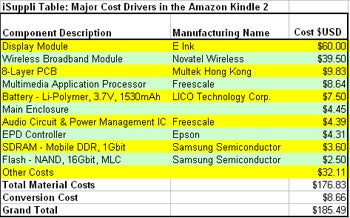
Amazon's second iteration of its popular eBook reader, The Kindle, costs only $185.49 to build, $173.51 less than its retail price, according to an iSuppli Teardown report (see below). When the conversion costs -- manufacturing expenses and the battery -- are stripped away, the price inflation weighs in at more than 50 percent. So what's making the Kindle 2 so pricey?
E Ink
The Kindle's E Ink display gobbles up 41.5 percent ($60) of the materials cost, as it's the most advanced technology included in the device and also the centerpiece of the reader. Funny, given that the latest E Ink upgrades have provided users with more eye-squinting headaches than previous versions.
Wireless
The original Kindle's wireless broadband card was built into the main circuit board. The Kindle 2's connectivity module, provided by Novatel Wireless, has been divorced from the core and accounts for 27.3 percent ($39.50) of the total cost.
The Rest
iSuppli doesn't touch a variety of other Kindle 2 components that raise its price. For instance, the teardown company does not factor in software, intellectual property, licensing fees, shipping, logistics marketing, or any of the other components necessary to not only have a physical device, but a physical device that functions. Voracious readers fear not: there still exist justifications for purchasing the Kindle 2, despite its hefty teardown price -- but only if you consume many books per month
The Mozilla Foundation says it is still on track to release Firefox 3.5 Beta 4 sometime later this week despite the lack of a firm release date. Beta 4 will likely be the last test version before Mozilla moves on to the release candidate of Firefox 3.5. However, Mozilla has not made good on many of Firefox 3.5's deadlines: earlier this year, Mozilla delayed the release of Beta 3 -- twice -- before moving on to Beta 4, as well as dumping the name Firefox 3.1 for the snappier Firefox 3.5 to reflect the significant differences between versions 3.0 and 3.5.
Most of the previous delays stemmed from Firefox's new JavaScript engine, TraceMonkey, which promises to speed up page loads two times faster than Firefox 3.0 and nine times faster than Firefox 2.0. At the moment, Beta 4 contains seven high-priority bugs requiring fixes, five of which involve the JavaScript engine.
When it is finally ready for mass adoption, Firefox 3.5 promises some new features largely based on HTML 5 -- the latest update to the core language of the World Wide Web. Mozilla says Firefox 3.5 will deliver noticeably improved performance, security and a better user experience overall. More specific features include:
* Audio and video elements that free media from being dependent on plug-ins, and give Web developers greater control over how media will appear on a Web page * Capability to drag and drop elements within and among Websites * Private browsing feature that prevents Firefox from recording your Web activities * One-click deletion for specific Websites: similar to private browsing, right clicking and selecting "forget about this" for any Website in Firefox's Web history will delete all history records relating to that Website. * Wi-Fi based geolocation (opt-in feature) * Downloadable fonts so pages look exactly as the designer intended
While Mozilla works to resolve problems with Firefox 3.5, the foundation is also hard at work on Firefox 3.0. Today, Mozilla released Firefox 3.0.9 update with 12 security fixes -- four of which were critical. Today's update was the largest security patch for Firefox since December 2008, but the second security update in the last four weeks. In late March, Mozilla released a fix for the so-called 'zero day' flaw after a German hacker exploited the browser to help him win US$15,000 during the Pwn2Own competition at the CanSecWest conference.
Amazon is now offering over 500 movies and TV shows in high-definition through its Video On Demand service. Major Hollywood studios and television networks have partnered with Amazon to bring recent movie releases and popular TV shows in HD to your TV--provided you have the right third-party hardware gear.
If you have a Roku digital video player, TiVo Series3, Sony Bravia Internet Video Link, an HD or HD XL DVR, or a Panasonic VIERA CAST-enabled TV, then you can rent HD movies for $3.99 to $4.99 and TV episodes purchases for $2.99 each. PC and Mac users can also get a dose of HD content through Amazon's online rental service. But only standard definition movies and TV shows in the HD format are available via your PCs.
Big-name Amazon partners include Warner Bros. Entertainment, Sony Pictures, Paramount, Metro-Goldwyn-Mayer and Universal. Some titles available include recently released movies Twilight and Yes Man and TV series The Tudors and Gossip Girl.
On TiVo, the company says, the majority of HD movies rented through Amazon's service will come with Dolby Digital 5.1 surround sound, while on Roku boxes the HD video will be streamed in 720p quality. On Roku boxes, the Amazon interface allows users to rent movies or purchase shows directly, unlike on Netflix where you have to manage your viewing queue from a PC.
The Bluetooth Special Interest Group today officially launched Bluetooth 3.0 with some big claims for the short-range wireless standard. The biggest improvement for the new standard is speed, which jumps from a top transfer rate of 3 Mbps found in the current Bluetooth standard to 24 Mbps in 3.0, according to the Bluetooth SIG. Faster speeds are accomplished because 3.0 employs the 802.11 radio protocol--basically allowing the Bluetooth protocol to piggyback on a Wi-Fi signal when transferring large amounts of data like videos, music and photos.
However, laboratory tested speeds don't always work out as advertised when used in everyday scenarios. Nevertheless, in an e-mail interview Michael Foley, executive director of the Bluetooth SIG, stands behind the speed claims adding that the average user will experience transfer rates between 22-26 Mbps with 3.0. This is a great advantage for devices that use an ad hoc connection, because it means you can transfer data between two devices at high speed without using a USB cable or logging on to a Wi-Fi network.
Other new and notable Bluetooth features include Unicast Connectionless Data giving 3.0 devices improved responsiveness and noticeably better battery life; and Enhanced Power Control which reduces the incidence of disconnects caused by movement such as placing a phone in pocket or purse.
From its All-Hands Meeting in Tokyo today, the Bluetooth SIG said manufacturers Atheros, Broadcom and CSR are already shipping 3.0 computer chips to device manufacturers and 3.0-enabled gadgets should be on store shelves within the next 9-12 months. There's no word yet on what devices will be the first to benefit from the faster Bluetooth speeds. But Foley says he's seen interest from computer and cellular phone makers, and even Television manufacturers.
While it's pretty much a given that computers and mobile phones will employ the new standard, TV makers are not a part of the typical Bluetooth crowd making it interesting to see if any TV makers adopt Bluetooth into their sets. If they did, it wouldn't be the first time TV makers had flirted with Bluetooth. As recently as last summer, LG Electronics announced its 7000-series of LCD and Plasma televisions would let you use wireless headphones via Bluetooth. Wireless headphones are one of the more common uses for Bluetooth, but with the faster transfer rates television manufacturers may find more interesting uses for 3.0.
With faster speeds, Bluetooth 3.0 promises to help increase adoption among users and manufacturers; however 3.0 also faces competition from an emerging short-range standard: Wireless USB. Using ultrawideband (UWB) technology, Wireless USB claims blazing fast speeds of up to 480Mbps between two devices within ten feet of each other.
Yet there is a possibility that Bluetooth could adopt UWB since the technology's guardian, the WiMedia Alliance, last month transferred the specifications for the UWB radio to the Bluetooth SIG and the Wireless USB Promoter Group. "Should UWB prove viable," Foley said. "It could be considered for a version of Bluetooth technology down the road, but at this point it's too early to tell."
For the moment, Bluetooth has staked its future on the more familiar 802.11 protocol, and you can be sure that PC World will put Foley's speed claims to the test once 3.0 devices become available.
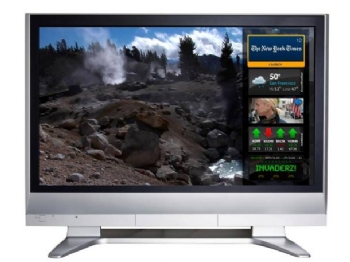
Coming soon to a TV screen near you - Flash. Adobe says it is working to bring its Flash technology to Net-connected TVs that will be able to playback videos and offer Web-like interactivity. Adobe announced its push into home theater devices including HDTVs, set-top boxes, and Blu-ray players on Monday.
The company says it has forged a partnership with Intel and set-top box manufacturers. It also says it has partnered with content and cable companies such as Disney, Netflix, Comcast, and The New York Times. The first TVs to include Flash technology that Adobe is working to develop are expected to show up on retail shelves next year, Adobe says.
Flash interactivity has actually already made it to HDTVs from LG, Samsung, Sony, and Vizio in form of Yahoo Widgets. PC World spotted many HDTV models at this past Consumer Electronics Show sporting Yahoo Widgets. Yahoo has touted partnerships with hardware and content partners such as Intel, Netflix, and Google's YouTube division.
I love the idea of having Flash-based video (Hulu and YouTube) accessible through my TV without having to use third-party hardware such as a set-top-box. My fingers are crossed the Flash technology won't be tweaked to deliver pop-up ads, annoying interstitial ads, and contextually relevant Google banner ads while watching primetime TV from my couch.
What's next for Adobe to concur after invading our PCs and HDTVs?
Adobe is slowly penetrating the mobile phone market also, with a slimmed-down version of the Flash player already available for various smartphones. Apple iPhone and iPod Touch devices are next expected to get flash video capabilities, together with Google Android phones.
Microsoft plans to offer a netbook-friendly version of Windows 7 that can only run three programs at a time and has a less robust graphical interface than the complete version of Windows 7.
Called Starter, Microsoft plans to offer the low powered OS as a viable competitor in the netbook market, while also giving netbook customers the option to upgrade to a complete version of Windows 7 if they want to.
Microsoft is desperate for Windows to remain the netbook OS of choice after it began to compete seriously with Linux -- an early favorite for netbooks -- at the outset of 2009. This is important since netbooks are expected to be the most popular devices among consumers in the coming months. In fact, the market research firm Gartner expects netbooks will grow by 81 percent this year, and credits the compact units for keeping PC shipments growing in some markets (notably Europe).
While Microsoft may be pinning its hopes to Windows 7, it's not clear how users will react to a limited OS like Starter. First of all, if Starter can run only three programs in practice doesn't that really mean you can only keep two applications open plus an antivirus program? That may make Windows 7 for netbooks a 'non-Starter' right there. Also, some users may see switching over to Windows 7 Starter from XP as a downgrade since a netbook running XP is only limited to what it can do by the computer's processing power. But more importantly, Windows -- while still the dominant OS overall -- is not the only user-friendly system you can find at an affordable price. Every year, Linux becomes more attractive to the average user and is expected to improve even more over time.
There are also reports that Google's Android OS may jump to the netbook from the smart phone, meaning even greater choice for users. To be a viable competitor, then, Windows 7 Starter will have to be a very compelling operating system. Not only that, but I expect many of you netbook customers out there would be unwilling to upgrade to a more complete version of Windows 7 -- depending on the price tag, of course.
Then again, while Windows 7 Starter may be less attractive because it can run only three programs at a time, a more complete version may not be necessary for a netbook. Consider my own situation: As I'm writing this, I am running iTunes, an instant messaging program, Firefox, and Gmail Notifier. Yet I could choose to run every single one of these functions through my Web browser.
In fact, I'm already moving away from my desktop and into the cloud since I'm writing this post on Google Docs and keeping up on Twitter with the TwitterFox browser add-on. All I'd need to do is stream my music through a service like LaLa or Project Playlist; run my IM through Meebo; and keep my Gmail tab open and I'd achieve the same results I have now while using only one program. Of course, if you plan to use your netbook as your primary computer, then a limited OS like Windows 7 may not work; but as a secondary device, a netbook loaded with Starter and a high-speed Internet connection may be all you need.
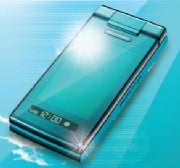
Cell phone addicts, listen up: The dreaded low-battery beep may soon be a thing of the past. Sharp has just unveiled the world's first solar-powered cell phone. Ready to get charged?
The phone, created by Sharp and Japanese network KDDI, is set to be released this summer. It works by using a special solar panel that snaps onto the device and soaks up the sun's rays. The companies say 10 minutes in the sun will give you enough juice for about a minute of talk time, or two full hours of standby power.
Even better for the tech-obsessed: Both the solar panel and the phone are fully waterproof. Conducting business poolside has never been simpler.
Other cell phone vendors are showing prototypes of solar-powered cell phones, and a number of solar chargers are avaiable for various electronics, including cell phones. But Sharp -- which has committed to solar power plants -- appears to be the first out of the gate with a solar-powered cell phone.
Unfortunately, the phones are only being released in Japan thus far, and there's no word yet when they could make their way to the States. The minute they do, though, consider my office officially relocated to the giant gator-shaped raft floating in the deep end.
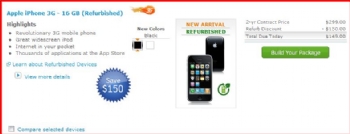
So it appears at the AT&T Wireless site, where a refurbished 16GB iPhone 3G is now selling for a suspiciously low $149 -- a 50 percent discount off the $299 regular price. True, it’s a refurb, which means it may have a scratch or two, and its warranty period is most likely a mere 90 days. You’ll have to sign a two-year contract too.
But even with those minor caveats, that’s a damn good price for a 16GB iPhone 3G. And the fire-sale price is certainly another indication of Apple’s efforts to clear out inventory to make way for the next-generation iPhone, which is rumored to debut as early as June.
Of course, pre-owned iPhones (“used” is such an ugly term, just as with cars) have been available for a few months now. AT&T in December began selling refurbished 8GB models for just $99, and Best Buy in January launched a somewhat pricier deal: $149 for a “refreshed” 8GB iPhone 3G; and $249 for the 16GB version.
The question for iPhone shoppers: Is it smarter to snag a bargain now, or what to see what goodies ? And if you go with the 3G now, what will it cost to upgrade to the latest handset?
AT&T is doubling the download capacity of its HSPA 3G network just before a new iPhone device is expected to launch. The new speeds take AT&T's capacity from 3.6 Mbps to 7.2 Mbps for 3G devices. Called HSPA+, the tweaked network is currently in two test markets and will roll out across the country later this year, according to Telephony Online.
The news of increased 3G capacity from AT&T comes less than two months before Apple plans to launch the third iPhone operating system at the World Wide Developer's Conference in San Francisco. Apple is already testing iPhone devices on HSPA+, according to reports, and the faster AT&T service could arrive as soon as May 31. That's just in time for WWDC where Apple is widely expected to launch a brand new iPhone device. A new iPhone would undoubtedly send another deluge of customers towards AT&T's service, and the company is loath to repeat the problems reported when iPhone 3G first launched last summer. Instead, AT&T would be better off to have noticeable speed improvements ready just as it did when the original iPhone launched on the AT&T EDGE network in 2007.
While the iPhone figures prominently in AT&T's plans, the mobile carrier also wants to open up 3G access to a wider range of products. At the CTIA Wireless conference last month, AT&T said it was looking at a wide range of 3G devices like eReaders, digital cameras, and of course netbooks embedded with 3G chips. AT&T could shake up its subscription plans as well and is considering models like a pay-per-upload scheme for digital cameras users. That would give you a more attractive way to take advantage of online photo storage and social networking straight from your camera without paying a monthly fee.
IPhone users and owners of other 3G devices will no doubt welcome the increased speed on AT&T's 3G network, but the AT&T network actually has the potential to go as high as 14.4 Mbps. However, Scott McElroy, vice president of AT&T Mobility, says it's unlikely customers will ever see those speeds on the 3G network. That's partially because AT&T has already spent a lot of development time on HSPA+, but AT&T also wants to begin testing its 4G network in test markets by 2010. McElroy told Telephony Online there's little point in migrating to 14.4 Mbps if AT&T can go straight to 21 Mbps.
The average selling price of Blu-ray players has been falling steadily -- it's now about $200 -- and there's little doubt that prices will keep dropping as Blu-ray goes mainstream and player shipments increase. But one report says the average price for entry-level Blu-ray players may to drop to as little as $99 in the very near future.
According to a Blu-ray.com report, Chinese manufacturers are preparing to enter the market for the high-definition video players, and this development could mean very aggressive prices for low-end Blu-ray hardware. The Blu-ray Disc Association recently began licensing Blu-ray technology in China, a move that has led Samsung marketing director Mark Leathan to speculate that $99 players aren't far off, the report states.
Does this mean we'll see a wide selection of sub-$100 Blu-ray players this holiday shopping season? That sounded a big optimistic, so we sought the advice of NPD Group industry analyst Stephen Baker, who's also skeptical at this point.
"Black Friday, maybe. It's entirely possible you could see a few players down at that price level," says Baker, who adds that it's a little early to speculate about holiday prices. The industry will have a better idea of holiday pricing by mid-summer.
Another issue is just how stripped down those entry-level Blu-ray players might be. Sure, they'll play discs, but what about the latest bells and whistles? Will they have BD-Live, also known as Blu-ray Disc Profile 2.0, which supports Ethernet connectivity, storage, and interactive features? Will they offer high-end audio decoders or Internet streaming via content providers such as Netflix, CinemaNow, Pandora, and YouTube to your HDTV?
It's unlikely that established players such as Panasonic, Samsung, and Sony will sell sub-$100 Blu-ray players, but rather they'll leave the low end to the Chinese upstarts and other value-sector brands like Magnavox and Sylvania, the Blu-ray.com report says.
Google took the wraps off a partnership with Hollywood studios bringing movies and TV shows to U.S. consumers via its YouTube video network. Some of the big-named partners inking a deal with YouTube are Sony, CBS, Metro-Goldwyn-Mayer, BBC, and independent film studio Lions Gate Entertainment. Each agreed to showcase some of its catalog content on the Google-owned video site.
Separated from the plethora of user-generated videos, the shows and movies are situated in a dedicated Shows section on YouTube, available from the main page. The content offered will be free to view but it is supported by ads -- the revenue being shared with content owners.
YouTube's move to premium content comes to counter the ever-growing popularity of sites like Hulu, which freely offer movies and TV shows for viewing. However, most of the studio movies and shows added on YouTube are more than a decade old (Fantasy Island, Alf, Party of Five), while NBC-owned Hulu offers most of the new shows just a few days after they air on TV.
Google is hoping that these full-length movies and video will help YouTube salvage through advertising revenue some of the over $500 million some predict it loses yearly on bandwidth costs. Google TV Ads, also introduced yesterday, will place commercials into the ad breaks of TV programs watched online (the ads cannot be skipped).
According to measurement firm Nielsen, YouTube accounts for two-thirds of all video views in the U.S., and last month the site had over 90 million visitors according to comScore.
Artwork: Chip Taylor Will Blu-ray finally get some respect? The high-definition optical disc format has long been the whipping boy of media pundits, many of whom predict consumers will spurn Blu-ray and gravitate instead toward video-on-demand, online download, and movie streaming services. Blu-ray is old school, they say, a relic of the bygone era of physical media, despite the fact that it bested challenger HD DVD in 2008 after a two-year high-def format war.
But don't nail Blu-ray's coffin shut just yet. A new study from Adams Media Research shows that sales of Blu-ray discs in the first quarter of 2009 nearly doubled compared to the same period a year ago, rising to nearly 9 million from 4.8 million in Q1 2008. Sales soared even though Blu-ray players and discs remain pricier than their DVD counterparts, although Hollywood studios have wisely begun to slash prices of some Blu-ray titles.
Does this mean Blu-ray has a future after all? It certainly appears so. Lower prices may be helping. Many Blu-ray players are now under $200, and Blu-ray movies sell for a little as $10. The HD format displays a prettier picture -- albeit not dramatically so -- than the HD content delivered by video-on-demand and online movie download and streaming services.
Consumer adoption of HDTV is certainly helping Blu-ray, although many users may never upgrade from DVD, or else they'll opt for a less expensive DVD player that upconverts DVD movies to HD quality. Or, as some believe, they'll simply ditch the discs altogether. But if they abandon movies-on-disc, much as they've already abandoned audio CDs, what explains the dramatic increase in Blu-ray disc sales?
This year should show whether Blu-ray's got staying power, or whether it'll die off like HD DVD.
The Wall Street Journal has jumped on the mobile content bandwagon and released an application for the iPhone. The financial newspaper set the price point at free -- ironic, given that the Journal's online content comes at a price of $103 per year, or $140 for the print edition.
The application looks and feels a lot like The New York Times iPhone app , replete with screen-hogging advertisements; headlines; editor's picks; and browsing capabilities for the newspaper's various categories. The WSJ app also offers video and radio sections, adding multimedia the Times does not have.
Blackberry received its free Wall Street Journal app last August, so the arrival of a similar app for the iPhone should come as no surprise. But why would a paid subscription-based online newspaper hand away its content for free?
When the current battle between the Associated Press and news aggregators such as Google is taken into consideration, the decision to release free content gets a little stranger. Obviously, it's in the Journal's best interests to collect as much dough for its content as possible, especially since newspapers are dying and the world is turning its attentions to online news. And Robert Thomson, the editor of the Journal, recently called free news aggregators "parasites or tech tapeworms in the intestines of the internet" -- which is particularly hilarious given that the Wall Street Journal is now one of those parasites.
Still, a newspaper that deals almost exclusively with finance should know when to charge and when to give away, and the Wall Street Journal likely does not see its iPhone and Blackberry apps as damaging to wsj.com.
SlingPlayer appears to be the latest victim in the never-ending saga of iPhone apps banned from the App Store. Reports this morning say that, at AT&T's request, Apple has made an executive decision to stop SlingPlayer from getting into the Apple App Store.
SlingPlayer for iPhone, introduced in January at Macworld Expo, conformed to Apple's guidelines for user interface. But with the iPhone crowd already clogging AT&T's data network, BoyGenius reports that the wireless carrier asked Apple to reject the SlingPlayer for iPhone application from its store.
Sling representatives say they had no word from Apple yet on the status of their iPhone app, and their Website still mentions they've "submitted the first release of our application to the iPhone App Store."
If AT&T actually asked Apple not to approve SlingPlayer for iPhone because of the potential use of large amounts of bandwidth, then the app might have to take the same route as Skype for iPhone, which allows placing calls only via Wi-Fi. If a modified version of SlingPlayer will allow viewing only through Wi-Fi, then it might actually make it in the App Store.
Meanwhile, another possible reason for SlingPlayer's ban from the App Store could be AT&T's speculated plans for its own mobile video services. The wireless carrier silently changed its terms of service at the end of March, basically prohibiting services like Sling is offering from its network.
But if AT&T won't get to keep its exclusivity with the iPhone, maybe this kind of won't happen anymore. That would allow users a bit more freedom with which apps they can get on their phone and how they actually use their (already capped) mobile Internet.
Sales of desktop PCs have been declining for some time now. In fact, notebooks now outsell their deskbound brethren worldwide. This trend isn't surprising, given the convenience, portability and growing affordability of portable PCs. Add to that the rapid ascension of the netbook, with its even smaller dimensions and prices, and shoppers are finding fewer reasons to purchase a bulky desktop unless they crave the ultimate in speed and storage.
But the recent reinvention of the all-in-one desktop, or nettop, may "reinvigorate and redefine" the traditional PC, according to market researcher DisplaySearch. While the all-in-one desktop with a flat-panel LCD screen (AIO LCD PC) has been around for years, computer buyers haven't exactly embraced the concept. In fact, all-in-ones have account for just 2% of the total desktop display market in any given year, according to DisplaySearch.
So why the sudden AIO bullishness? Because the new nettop PC melds the advantages of the hot netbook category-low price, slim design, and a relatively small footprint-with the ergonomically friendly (i.e., desktop) benefits of a larger LCD display and a full-size keyboard. Some nettops may include touch screens too.
As a result, the nettop is convenient for the cramped office cubicle, tiny home office, or student desk. Says DisplaySearch: "Based on the Intel® Atom processor microarchitecture, which helped to launch the mini-note category, nettops are expected to be a far cry from the existing AIO LCD PCs, which are typically feature-rich and high priced."
Affordability is key here. A nettop with a 18-5-inch LCD costs as little as $240 to $250 to build, and could sell for as little as $300 in some global markets, although a street price of $400 to $500 is probably more realistic, DisplaySearch estimates. Those low prices could boost all-in-one PC shipments (including nettops) to more than 6 million units worldwide this year, up from 3.5 million in 2008.
The nettop and netbook probably won't attract the same shopper. The netbook buyer is intrigued by the concept of anytime-anywhere computing, and is willing to sacrifice screen and keyboard size for convenience. The nettop buyer wants an inexpensive desktop experience without the bulk of a traditional tower PC. Performance may prove disappointing, however, particularly if nettop fans decide to try more than basic web browsing and word processing.
Even if conventional desktops survive, the trend toward cheaper, smaller computers is bound to continue.
Apple released last night a third beta build of the iPhone 3.0 software, taking developers one step closer to the final release in June. Arriving exactly two weeks after the previous build, the iPhone 3.0 third beta software build brings speed improvements and plenty of under-the-hood goodies.
One of the most significant additions to the latest beta of the iPhone 3.0 software is the way individual apps will be able to notify users of updates or additional content. At the moment, individual apps flag users only in iTunes of new events, but with the 3.0 build, they will be able to do so right on the phone via badge, text or sound notifications.
Developers are also reporting further improvements in the latest beta carrying the 7A280f build number: Spotlight (phone-wide search) will now let users save the last search they made, and can set restrictions for inside-application purchases and location data.
An interesting fact about the third beta of the iPhone 3.0 software is that the Skype app no longer works on 3G. With previous builds, Skype allowed 3.0 beta software users to place calls via 3G, unlike the same app on the current 2.2 platform, which can make calls only over Wi-Fi. Apple seems to have fixed this "bug," so no more wishful thinking for cheap VoIP in the 3.0 final release.
This third beta of the iPhone 3.0 software indicates the imminent arrival of a final 3.0 software in June, just like Apple promised. However, the question remains whether we will get some new iPhone hardware as well, especially as rumors intensified over the last weeks, detailing hardware components and features.
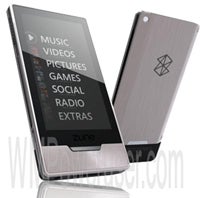
Source: WMPoweruser After the leaked pictures of the Zune HD appeared on Saturday, more unconfirmed technical specifications of the device have now emerged. Microsoft's new portable media player is set to go neck-to-neck with Apple's iPod Touch, as the specifications of the Zune HD make it a viable contender.
The Zune HD is set to feature a multitouch (capacitive) OLED screen in a 16:9 aspect ratio and will have a TV out port on the side (apparently HDMI). Coming in 16 and 32GB versions, the device will also support wireless syncing to your computer. Some even speculate the PMP will support 3D Xbox games, if the Zune HD will actually use Nvidia's Tegra chipset.
The new details also mention a Web browser on the Zune HD, which in turn supports multitouch. No word on what kind of browser this will be, but let's hope it won't be anything similar to Internet Explorer on Windows Mobile. As previously reported, the Zune HD is set to launch this fall (probably September) with new details of international availability in Canada, the U.K, and France.
What is Microsoft cooking?
The tech blogosphere is also talking today about Zune-themed mobile phones. AdWeek reports that Microsoft is now taking bids for an ad campaign for a Zune mobile application dubbed Pink.
While some speculate that the Zune HD is likely to run on the long-overdue Windows Mobile 6.5 (expected in Q4, same as the Zune HD), it's more likely that WM phones would just share some services and feature with the new Zune.
The 4.7.0.113 update will also bring a much-wanted feature to Storm users: a full QWERTY keyboard to use in portrait mode. So far, the BlackBerry Storm allows the use of a full QWERTY only in landscape mode, while a SureType keyboard is used in portrait mode. In total, over 30 bugs will be fixed, with stability and speed issues addressed in this firmware update as well.
Some BlackBerry forums and Web sites already offer various versions of this update for download. If you know what you're doing, you can try an unofficial update at your own risk. However, I would recommend you wait until the official version from Verizon will be released.
This might well be the last firmware update RIM will offer for the Storm, as the company is already working on the Storm 2. The second iteration of RIM's flagship phone is said to add Wi-Fi, a 5-megapixel camera, and a new touchscreen technology called TruePress.
But from AT&T's point of view, the privilege of selling the iPhone is worth the cost. The big telecoms are moving away from landline service and looking to wireless as the industry's future. The WSJ says AT&T has already spent $18.8 billion in purchasing wireless spectrum and smaller wireless companies as it prepares for the coming years. AT&T may also cut out the requirement that you be an AT&T landline customer to qualify for discounts on TV or broadband service.
While holding onto the iPhone may make sense for AT&T, an extension isn't in the best interests of the consumer or Apple. Let's face it, millions of people around the U.S are salivating over the iPhone, but aren't switching over to AT&T. This can be for a variety of reasons like being locked into a contract, availability of AT&T service in certain areas, and even plain old brand loyalty. Apple needs to reach out to this much larger base of customers, especially with competition coming from the Palm Pre and an anticipated slew of devices coming loaded with Google's Android platform.
Opening up the iPhone to other carriers also has the potential to reshape the American wireless market. With so much hype behind it, Apple is in a position to dictate terms to service providers. Carriers could end up offering competing rebates, free devices, or other goodies in order to satisfy your iPhone lust.
I hope AT&T's time in the iPhone limelight is fading. It's time Apple unshackle the so-called "Jesus phone" from AT&T so we can see some iPhone competition in the U.S. marketplace.
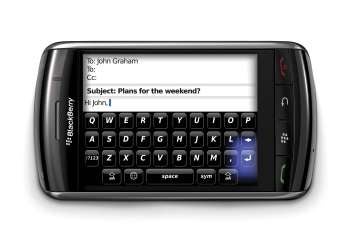
The BlackBerry Storm, the first touchscreen device from Research In Motion, is to get a software update over the coming two weeks. The new firmware is set to fix multiple bugs plaguing the phone, as well as add features such as improved keyboard usage.
The over-the-air software update from Verizon Wireless will be the first major update for the Storm since one in December. Known as 4.7.0.113, the new firmware is expected to fix numerous bugs the Storm is suffering from, stopping the device from freezing when using voice dialing, and fixing the bug that causes the display to get filled with small, multicolored dots.
The 4.7.0.113 update will also bring a much-wanted feature to Storm users: a full QWERTY keyboard to use in portrait mode. So far, the BlackBerry Storm allows the use of a full QWERTY only in landscape mode, while a SureType keyboard is used in portrait mode. In total, over 30 bugs will be fixed, with stability and speed issues addressed in this firmware update as well.
Some BlackBerry forums and Web sites already offer various versions of this update for download. If you know what you're doing, you can try an unofficial update at your own risk. However, I would recommend you wait until the official version from Verizon will be released.
This might well be the last firmware update RIM will offer for the Storm, as the company is already working on the Storm 2. The second iteration of RIM's flagship phone is said to add Wi-Fi, a 5-megapixel camera, and a new touchscreen technology called TruePress.
Virgin Mobile USA today announced drastic cuts to its prepaid monthly calling plans, introduced an SMS-only plan, and announced that it will cover the phone costs for its jobless customers. Starting April 15, Virgin Mobile USA customers can get unlimited calling for $50 per month, $30 less than the current unlimited plan. Two of Virgin's other monthly calling plans also get a price cut: 300 anytime minutes and 1,000 7PM Nights/Weekend minutes for $30 (down from $35) and 400 anytime minutes plus unlimited Nights/Weekend minutes for $40 (down from $50).
Messaging Madness
In a nod to the growing popularity of Multimedia Messaging (MMS) and micro-blogging services like Twitter, Virgin Mobile unveiled its new Texter's Delight plan. For $15 a month you can 1000 MMS every month or for $20 you can get an unlimited monthly texting plan. Texter's Delight covers Text, IM, Email, Photo, and Video messages. If you still like to have the occasional telephone conversation, Texter's Delight will charge you 10 cents per minute for every phone call.
Virgin Mobile Bailout
Virgin has also introduced a Pink Slip Protection (PSP) program to bail out customers who lose their jobs in this tough economic climate. To be eligible for PSP, you must be a Virgin Mobile USA customer for two consecutive months prior to losing your job, and become eligible for state unemployment benefits within 12 months. If you meet these restrictions, Virgin Mobile will cover the costs of your plan including taxes and surcharges for up to three months. New monthly calling plan customers will be automatically enrolled for Pink Slip Protection and current customers have an open enrollment period until June 30.
Wireless competition is starting to heat up as customers search for lower and more effective ways to cut their costs. Virgin Mobile's new plans are in response to other competitors recently dropping their prices including Metro PCS, Leap Wireless and Sprint's Boost mobile. Virgin first introduced unlimited calling plans last summer after major carriers such as Verizon, Sprint, AT&T, and T-Mobile did the same. The new plans and Pink Slip Protection will be available from Virgin Mobile as of April 15.
The Conficker worm is back in action and stumping security experts once again. One of the most craftily designed pieces of malware recently got an update and is finally starting to behave like other worms. Here's what's going on:
New Marching Orders
On Wednesday, April 8 security firms started seeing some variants of Conficker C, the latest Conficker flavor, receive updates through its encrypted peer-to-peer (P2P) file-sharing functionality. Security Firm Trend Micro reports that the new Conficker instructions came from a server in Korea and the new file was created on April 7, 2009 at 07:41:21. The new update strengthened Conficker's defenses and the new Conficker functions will shut down on May 3, 2009.
Until May 3, the refreshed Conficker will search the Internet for uninfected Windows machines that have not applied the Microsoft MS08-67 security patch. This search-and-infect functionality was turned off in previous Conficker varieties, presumably to control the size of a future botnet. However, it seems Conficker's authors have rethought that strategy and are looking to grow their creation once more. Some Conficker variants are also programmed to infect an unpatched computer, and then once Conficker is in the machine the worm patches up the weakness to keep out other types of malware that capitalize on the same vulnerability.
Once Conficker infects a new machine or gets its refresh, it tries to connect to MySpace.com, MSN.com, Ebay.com, CNN.com, and AOL.com to verify the computer is conn
ected to the Internet.
Conficker's first scam revealed
The new Conficker has also started to exhibit signs of traditional malware. Using one of the oldest tricks in the book, called scareware, the new Conficker C downloads a fake antivirus program called Spyware Protect 2009 (pictured). F-Secure says it's called Spyware Guard 2008. The fake program then delivers a pop-up message telling you that your computer is infected, but for only $49.95 the fake antivirus program can remove the malware. You are then directed to a bogus website where you unwittingly enter all your credit card information and then the criminals are laughing all the way to the bank -- your bank, that is. The scareware scam seems to be coming from a server in the Ukraine, according to the Washington Post.
Conficker: Spambot in disguise?
Conficker, being a tricky little piece of programming, seems to be connected in some way to the Waledac worm -- and Waledac itself is considered to be an update of the Storm Worm. There is no consensus about what Conficker is actually doing, but according to the security firm F-Secure, Conficker is going to a domain known to be associated with Waledac and actually downloading the Waledac worm. Trend Micro, meanwhile, says Conficker is downloading some code from the Waledac domain, but the security firm wants to do further studies before confirming a Conficker-Waledac connection. However, Trend Micro suggests that Conficker may be getting ready to work as a large-scale spamming botnet, a known function of the Waledac worm.
Conficker: More than meets the eye
Apparently the new Conficker has more tricks up its sleeve that researchers have yet to uncover. While security teams try to uncover all of Conficker's latest tricks and tweaks, they do know that Conficker is awake and the worm's authors are beginning to use Conficker-infected machines to make money. Just how far this will go is unknown at the moment.
Where do we go from here?
As security researchers begin to unravel the mysteries surrounding the latest version of Conficker, you can protect yourself from the worm by first testing your system for infection and then by making sure you have the latest Microsoft Security patches and that your antivirus program is up to date. The Conficker Working Group has a simple test to see if you're infected with Conficker.
The Bluetooth 3.0 buzz is building. The short-range wireless standard Bluetooth 3.0 will get its official launch on April 21. The developers of the standard, the Bluetooth Special Interest Group, have confirmed multiple reports forecasting the release of Bluetooth 3.0 specs. According to the Bluetooth SIG on April 21 it will announce the groups latest Bluetooth standard. At that time the Bluetooth 3.0 specifications will be unveiled.
Here's What We Know About Bluetooth 3.0
The Bluetooth 3.0 standard is expected to deliver even faster short-range wireless speeds (up to 480 Mbit/s), improvements to reduce chances of device disconnections when syncing, and the addition of Generic Alternate MAC/PHY (AMP) technology that will reportedly allow Bluetooth 3.0 devices to transfer data at speed on par with Wi-Fi. Another advancement will allow the Bluetooth wireless frequency to piggyback on the Wi-Fi 802.11 protocol - in affect allowing Bluetooth over Wi-Fi. We'll have to wait until April 21 to find out more.
What's unique about Bluetooth is its low cost and low power consumption, allowing it to be used in devices such as cell phones where cost and power consumption are huge concerns for developers. However, Bluetooth technology has struggled in its efforts to be adopted widely.
What the blogs are saying
The Bluetooth SIG claims Bluetooth 3.0 can wirelessly transfer an entire music library, a complete DVD [or] a vacation's worth of photos, all within seconds, according to the blog the Bluetooth SIG. In addition to pumped-up speed, Bluetooth 3.0 could also feature "Enhanced Power Control," which reduces those annoying headset disconnects caused by putting your phone in your pocket or purse.
There are no details at the moment about Bluetooth 3.0-ready devices, but most Bluetooth watchers expect the Bluetooth SIG to release a list of manufacturers that have products ready to go at the Bluetooth 3.0 launch on April 21.
Bluetooth in the smart phone age
The new Bluetooth standard comes as smart phones are growing way beyond e-mail and voice calling into full-fledged mini-computers. For some time now, cell phone users have turned to Bluetooth for wireless headsets and to sync calendar and contact information. Now that many people are listening to music and watching movies on their mobile devices, Bluetooth needed to get faster to remain an effective solution for wireless syncing.
In the meantime, Bluetooth technology will have to compete with the Wireless USB standard that is going in popularity and influence.
We will keep digging and will update this post once we can independently confirm announcement details from the Bluetooth SIG.
Remember CompUSA? The electronics retailer may have closed up shop in your town, but it never shut down entirely. As reported by PC World’s Tom Spring last January, Systemax paid $30 million for select CompUSA assets and retail stores in a deal that kept 16 CompUSA locations open. Systemax subsidiary TigerDirect then took over the CompUSA brand, and even converted some TigerDirect stores to CompUSA shops.
Resurrecting a consumer electronics chain with a less-than-stellar reputation for service and support is a risky move for Systemax, which figured that TigerDirect could rebuild the brand. It may prove to be a smart move too. Consumers have short memories, and many will likely remember the CompUSA name and not the baggage that went with it.
Now Systemax is trying another bold move by allowing customers in its 30 CompUSA stores to surf the Web to comparison shop. According to Wired, in addition to better lighting and an updated store design, each CompUSA will have Web terminals that shoppers can use to find cheaper deals online. But will CompUSA meet or beat the online price?s
In-store comparison shopping is a risky move that could drive away customers who find better deals elsewhere. Then again, it may also draw customers who appreciate the consumer-friendly approach. I hope the new CompUSA succeeds. Best Buy needs more brick-and-mortar competitors, particularly after the recent demise of Circuit City.
Microsoft has unveiled its latest "Laptop Hunter" ad, throwing back a powerful punch against Apple's long-running (and, by most counts, long-winning) campaign on coolness. Unlike Microsoft's past attempts, this new line of marketing has many ad experts taking note -- and saying maybe, just maybe, Microsoft has finally hit the mark.
Microsoft's Laptop Hunter Ad
The new "Laptop Hunter" spot, the third in Microsoft's latest ad series, shows a mom and son trying to find a laptop for less than $1500. Microsoft offers to pay the price of the computer if they can find one within that range.
The ad follows similar spots debuted this month, one featuring a guy named Giampaolo and the other with a gal named Lauren. Both went on similar missions to find inexpensive laptops and, after comparing Macs and PCs, ended up going with Microsoft's platform.
That distinction may serve Microsoft well, says Matt McCutchin, a former ad copywriter who's worked on numerous Microsoft and PC-related campaigns in the past.
"It was a great strategy a year ago to try to kick the door open and get the buzz going, to get Microsoft talked about in a different way," says McCutchin, a lecturer in the University of Texas at Austin's advertising program. "I think that bringing it home to the actual shopping trip is the right next step. That's what really goes through a consumer's mind now."
Future Thinking
This latest ad is the third in a series of six "Laptop Hunter" spots scheduled to be released over the coming months. The segments are little-by-little upping the ante: While an early edition focused on a machine under $1,000 and the most recent looked for a laptop less than $1,500, a future spot is said to raise the price limit to $2,000.
Microsoft is clearly aware of the edge that playing up price can offer over its competition. A Microsoft brand exec even joked that it was a "good day" when Apple unveiled a $2700 MacBook Pro at this year's Macworld Expo. The question now is whether Apple will address the hits in a new way or continue pushing for success with its past tactics. McCutchin -- who recently made the switch himself, by the way, to Mac -- thinks a change may be in order.
"I would say it's time for Apple to evolve its strategy," he says. "They're going to have a harder time trying to justify those price points."
Unlike the Seinfeld ads, these latest spots offer nochurros or tight-running Conquistador shoes. In the long run, though, they may offer something far more valuable in Microsoft's ongoing rivalry with its cooler, but perhaps costlier, competitor.
"I think Apple's going to have to deal with the issue at some point," McCutchin contends. "That's why Microsoft's strategy is so well-timed in making this more about price and value as opposed to some sort of coolness."
You know all about the on-again, off-again PC-Mac turf war, of course. Which is better? One thing we can tell you is that PC makers sure are taking note of Apple's awesome design work. And that's the setup for the welterweight matchup we have going on today.
In this corner (pictured at right), the MacBook Air, the sleek standard-bearer for how Apple does computing. In the other, the Dell Adamo, the spunky up-and-comer that packs on ports…and takes some not-so-subtle jabs at the big "A."
Neither company really positions its ultraslim ultraportable as a high-performance hot rod. Heck, both of them eschew optical drives to stay lean and mean. But they're both expensive--very, very expensive. We figured it was time to find out if either the Air or the Adamo has what it takes to win.
Now before these two palookas start mixing it up, let's look at what they each bring to tonight's fight. The MacBook Air is the cagey vet. Since it first showed up on the scene, it has improved its game by providing better processors and an honest-to-goodness graphics card, nVidia's GeForce 9400M. That means it can actually play some games--not many, but some.
The Air we last reviewed offered a 1.86GHz Core 2 Duo CPU and 2GB of RAM, and scored a 78 in WorldBench 6. In our battery-life tests, the Air survived for about 2.5 hours before sputtering out. It can accommodate a 120GB hard disk (our more-expensive model came with a 128GB solid-state drive). But then, of course, there's also the dreaded "Apple Tax": These machines range in price from $1799 to $2499.
The Dell Adamo, on the other hand, offers lesser parts and…charges…more? Really? Let's go over this. Dell's high-style PCs cost between $1999 and $2699. The Adamo maxes out at a 1.4GHz CPU but compensates with 4GB of RAM to handle a 64-bit version of Windows Vista Home Premium. Supposedly its battery will last 5 hours in tests, if we're to believe promotional materials. Will it get slapped around in our WorldBench 6 suite? Stay tuned; we'll update this story as soon as we receive results from our labs. For now, though, buckle up for a feature-by-feature smackdown.
Hey, you two silicon status symbols: Are you ready to rumble? FIGHT!
Round 1: The Packaging
Apple: Ships in a neat little box. It's tiny. It's mostly white. It comes with a handle. Yay!
Dell: When the Adamo arrives at your doorstep, it looks as if someone froze your new laptop in carbonite. Yeah, I went there. It's a minimalistic plastic display case that houses the small handful of accessories (a DisplayPort-to-VGA cable, a power cable, and a microscopic manual) that come with the Adamo.
Winner: Draw. If you're going by cool factor, Dell out-Appled Apple in this department. Environmentally friendly plastic casing, not so much.
Round 2: The Keyboard
Apple: The Air didn't invent the notion of cut-out Chiclet keys--it just popularized them. The buttons are reasonably spaced, and you rarely run the risk of mistyping. That said, the function keys are shrunken down a little bit too much for my tastes. Otherwise, the Air has a slick set of backlit keys.
Dell: One editor here refers to the little dip in the middle of these wide keys as "finger buckets." The fancy-pants Dell marketspeak for it is "scalloped keys." Whatever. The point is, the keys are flat-ish and wide, as I've grown to love on a number of laptops (the HP Mini 1000 being among them), and they have a little lip for your fingers to rest in. The Adamo also finds room to accommodate a couple of multimedia-shortcut keys next to the power button. The only drawback here is that making out some of the keys without the ambient backlighting turned on is a little difficult.
Winner: Dell. Bigger keys and more of them equal a win in my book.
Round 3: The Touchpad
Apple: Looking at the touchpad, it's pretty obvious why the Air gave up some ground from the keyboard. The mousing area on the MacBook is big and beautiful. While some people (ahem, me) have trouble with getting the multitouch functions to work 100 percent correctly, all the time, it feels--and looks--great.
Dell: The Adamo's touchpad borders on the average side. It's not bad by any stretch; the buttons are firmly in place and give the right amount of pressure. Like the Apple laptops, this Dell model provides some multitouch functionality as well.
Winner: Bigger surface area. Feels better. Apple.
Round 4: The I/O Ports
Apple: I can count the number of ports on three fingers. You can guess which ones they are. You get a single USB port, a mini-DisplayPort, and a headphone jack. That's it.
Dell: Here’s where the big "D" gets it right. The Adamo has two USB ports, ethernet and headphone jacks, one eSATA connector, one DisplayPort, and a user-accessible SIM-card slot for WWAN service.
Winner: Dell. As if this one was even going to be close. At least both machines offer Webcams and built-in microphones.
Round 5: The Screen
Apple: A crisp 13.3-inch display stays protected behind a big, aluminum bezel. With the Air's native 1280-by-800-pixel resolution, you'll get some great, colorful images on the backlit LED screen. Of course, the glossy coating means you're bound to get a little bounce-back in broad daylight, too.
Dell: Ditto on the glare from the glossy coating, but this screen is worth it. The Adamo offers edge-to-edge glass that's securely locked into place on the 13.4-inch screen. Its WLED display one-ups the Air's with a 1366-by-768-pixel resolution (translation: 720p-friendly). Initial tests show that the screen looks pretty sharp. But one thing I keep mulling over is the obviously Mac-esque shortcut bar that sits on the desktop (shown here). It provides clean, quick links to all the main apps you'd use on the computer. And it's easily customizable.
Winner: Dell. The Adamo has a bright, bigger screen with a higher resolution? Sold.
Round 6: The Overall Design
Apple: Thanks to its simple, spartan design, the Air has much cleaner lines. Then again, managing without all of the perks that have been nipped and tucked out of the 12.8-by-9.0-by-0.8-inch, 3-pound Air in order to make it so small is a bit of a pain. As in life, it's all about trade-offs.
Dell: As slim as the Adamo is (13 by 9.5 by 0.65 inches and 4 pounds), it's still a bit boxy. Hey, that's not a knock. After all, just about every laptop is a little on the square side (even Apples, until pretty recently). The dotted grillwork on the back pops, and the two-tone top makes the Adamo look more like a fashion accessory than most laptops on the scene do.
Winner: Draw. This one boils down to a matter of aesthetics and taste. Whether you like clean and simple or you want to try to match your shoes to your laptop, either machine works.
As I said at the beginning of this slide show, hang tight: We will have a full review of the Adamo up soon with all of our WorldBench 6 test results in place.
Audio-Technica's ATH-W5000 is a set of headphones with a decidedly retro feel. Packing high quality components into an over-the-ear design, the headphones have wooden outer covers for the ear-cups, making them instantly recognizable.
AKG K1000
Recognizable for a completely different reason, AKG’s K1000 headphones are essentially full-size speakers suspended over the listener’s head with the headband. Reminding us of broadcast studio microphones — sans the fuzzy covers — these headphones are as expensive as they are ingenious.
Audio-Technica ATH-EW9
As a smaller redesign of the ATH-W500, the ATH-EW9 from Audio-Technica is a set of clip-on headphones that sit on the listener's ears. With a metal ear-clip mechanism the ATH-EW9 headphones are a pleasant mix of retro and modern styling.
Sennheiser HE90 Orpheus
Novel for their bulk, prowess and price, Sennheiser's legendary HE90 Orpheus headphones are one of few models on the market to use electrostatic sound reproduction instead of the moving-coil design used by most headphones. The end result is peerless sound quality with the downside of requiring a dedicated, specially designed amplifier.
Logitech Curve
Slightly out of place in such prestigious company, Logitech's Curve headphones have been chosen because of their ultramodern headband and clip-on design. Molded out of lurid green plastic, the Curve headphones may not suit all tastes but certainly catch the eye.
Takara's Novelty Headphones
A list of novelty headphones can't be complete without at least one boutique Japanese cartoon design. These Takara headphones seem like generic clip-ons — until they unfold to reveal the plastic limbs of either Frenzy or Rumble, depending on which model you purchase. A licensed transforming MP3 player is also available.
Logitech Freepulse
Logitech's FreePulse headphones are the older, cooler brother of the earlier Curve. With Bluetooth technology and a thin band design, they’re stylish enough to be worn wherever you go.
Zelci Outi
These Zelco Outi earphones are designed to be attached to the outside of your ears rather than nestled inside. Transmitting their vibrations directly into your ear cartilage, the Outi are designed to reverberate sound through your entire body.
Skullcandy
If you want a zany design, you can't go past Skullcandy. With all of their models available in over-the-top finishes, you’re bound to make a statement 24/7.
Sony W Series
They aren't specifically headphones, but an honorable mention goes to Sony's new W Series MP3 player range. With a set of in-ear headphones built in to the MP3 player's body, you're literally wearing music. It does make changing songs interesting, though, using Sony's proprietary ZAPPIN technology.













 Artwork: Chip Taylor


 Source: WMPoweruser